- Region:
- World
- Category:
- Technology
Artemis II Crew Tests Spacesuits Ahead of Historic Lunar Flyby
-
![Artemis II Crew Tests Spacesuits Ahead of Historic Lunar Flyby.]()
Artemis II Crew Tests Spacesuits Ahead of Historic Lunar Flyby.
- Region:
- World
- Category:
- Technology
- Publication date:
NASA’s Artemis II mission is approaching one of its most important milestones: the spacecraft’s historic flyby of the Moon scheduled for Monday, April 6. Before that maneuver, the crew spent much of Flight Day 5 testing the new survival suits that will be used during the mission’s most critical phases.
Astronauts Reid Wiseman, Victor Glover, Christina Koch and Jeremy Hansen conducted a full demonstration of the Orion Crew Survival System, the bright orange suit designed to protect the crew during launch, re-entry and possible emergencies aboard the Orion spacecraft.
During the test, two astronauts put on the suits quickly while the other two followed the standard procedure, allowing NASA to evaluate how the system performs in weightlessness. The crew also tested new features including ports for food, water and medication.
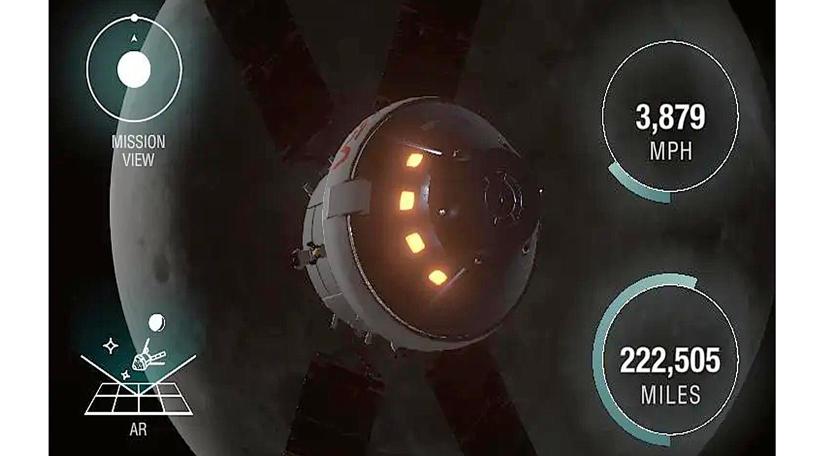
At the time of the exercise, the crew was about 65,000 miles from the Moon and nearing the point where lunar gravity would begin to dominate Orion’s trajectory. NASA also confirmed that the spacecraft completed a 17.5-second trajectory correction burn ahead of the flyby.
One of the mission’s most remarkable moments came when the astronauts became the first humans ever to observe the entire Orientale basin on the Moon’s far side, a massive feature previously seen only by robotic spacecraft.
Artemis II is also expected to set a new record for the farthest distance traveled by a human crew, reaching approximately 252,757 miles from Earth and surpassing Apollo 13.
The lunar flyby will include a roughly 40-minute communications blackout as the Moon blocks signals between Orion and Earth. During that period, the astronauts will photograph the Moon’s far side and a rare solar eclipse visible from deep space.
Artemis II is the first crewed mission to travel around the Moon since Apollo 17 in 1972 and serves as a rehearsal for Artemis III, the mission expected to return astronauts to the lunar surface in 2028.