- Region:
- America
- Category:
- Tourism
Caribbean Travel Trends 2026: Latin America Drives Demand as High-End Tourism Gains Momentum
-
![Caribbean Travel Trends 2026: Latin America Drives Demand as High-End Tourism Gains Momentum.]()
Caribbean Travel Trends 2026: Latin America Drives Demand as High-End Tourism Gains Momentum.
The Caribbean tourism industry is entering a new structural phase, where growth is no longer defined by post-pandemic recovery but by the ability of destinations to attract higher-value travelers, diversify source markets, and extend activity beyond traditional peak seasons, according to the Caribbean Travel Forum 2026 report.
The study, presented by the Caribbean Hotel and Tourism Association (CHTA) and Amadeus during Caribbean Travel Marketplace 2026 in Antigua, is based on travel intelligence data from April 2025 to March 2026. It shows that international demand for the region grew just 1% year-over-year, marking a sharp slowdown compared to the 21% and 8% increases recorded in the previous two years.
This shift reflects a broader transition in the Caribbean tourism model: from rapid expansion to a more strategic focus on segmentation, value generation, and demand optimization.
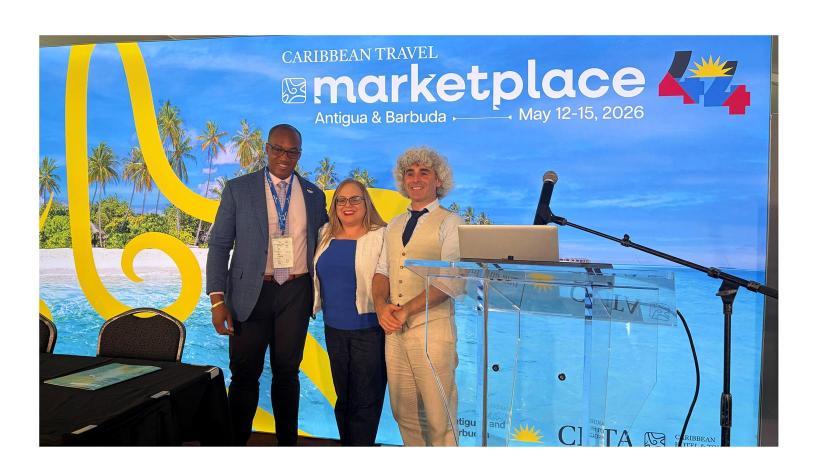
During the opening day of the Caribbean Travel Marketplace 2026, the CHTA press conference brought together senior industry leaders to present and expand on the findings of the Caribbean Travel Trends 2026 report. The session was opened by CHTA CEO Vanessa Ledesma, who emphasized public-private collaboration and the use of market intelligence as a key driver of competitiveness.
Also participating were CHTA President Sanovnik Destang and Olivier Ponti, who outlined the main findings and confirmed the slowdown in regional growth compared to previous years.
Together, they agreed that the Caribbean is undergoing a strategic transition in which volume is no longer the main metric of success. Instead, the focus is shifting toward economic value, market segmentation, and seasonality optimization.
Latin America emerges as the Caribbean’s key growth engine
One of the most significant findings of the report is the role of Latin America as a strategic source market, with a 24% year-over-year increase in travel to the Caribbean, making it one of the fastest-growing global regions.
High-income travel segments are expanding even faster. Luxury travel from South America increased by 117% over the past year, signaling a structural shift in traveler profiles.
Key markets include:
- Argentina: +164% in luxury travel
- Peru: +192% in luxury travel
- Brazil, Mexico, and Colombia: double-digit growth in overall demand
The report highlights that the five fastest-growing international source markets for the Caribbean are all in Latin America, confirming a decisive shift toward South America as a driver of both growth and diversification.
Secondary destinations reshape regional flows
Growth is also being driven by smaller and emerging Caribbean destinations, which collectively increased by 2% year-over-year. Standout performers include:
- Dominica (+22%)
- Sint Maarten (+18%)
- Saint Vincent and the Grenadines
- Guyana
This trend reflects a redistribution of tourism flows toward less massified destinations driven by connectivity improvements, nature-based tourism, and differentiated experiences.
Pricing competitiveness supports Caribbean demand
The report also underscores the Caribbean’s competitive positioning in global airfares. Average ticket prices from the United States to the Caribbean stand at around USD 385, below South America and comparable to Central America.
Miami remains the most cost-efficient gateway to the region, reinforcing its strategic role in hemispheric connectivity.
Hotel performance: strong high season, weak low season
Hotel performance remains stable during peak periods, with RevPAR reaching USD 183 in high season (+5.2%), and up to USD 283 during year-end peaks.
However, low season performance remains weaker at USD 125, highlighting one of the region’s key structural challenges.
Latin America is emerging as a solution to this imbalance:
- Brazil: +60% growth in low season demand
- Colombia: +26% growth in low season demand
These markets are increasingly important for reducing seasonality and stabilizing occupancy rates.
Culture and data as demand drivers
The report also highlights the impact of cultural events such as CARIFESTA XV, which generated a 23% increase in arrivals and longer average stays, reinforcing the role of cultural programming in destination marketing.
A data-driven tourism model for the Caribbean
CHTA President Sanovnik Destang emphasized that the industry is entering a more strategic phase where data, diversification, and competitiveness will define future growth.
He called for standardized performance metrics beyond arrivals, incorporating value, profitability, and seasonality indicators.
Amadeus reinforced that the challenge is no longer only understanding demand, but actively shaping it through advanced segmentation and early-stage traveler engagement.