- Region:
- World
- Category:
- Politics
Why Singapore for the Trump-Kim summit?
-
![Singapore also confirmed it would host the meeting, but did not give further details.]()
The ultramodern city-state has a robust security infrastructure and is widely considered one of the safest cities in Asia. Singapore also confirmed it would host the meeting, but did not give further details.
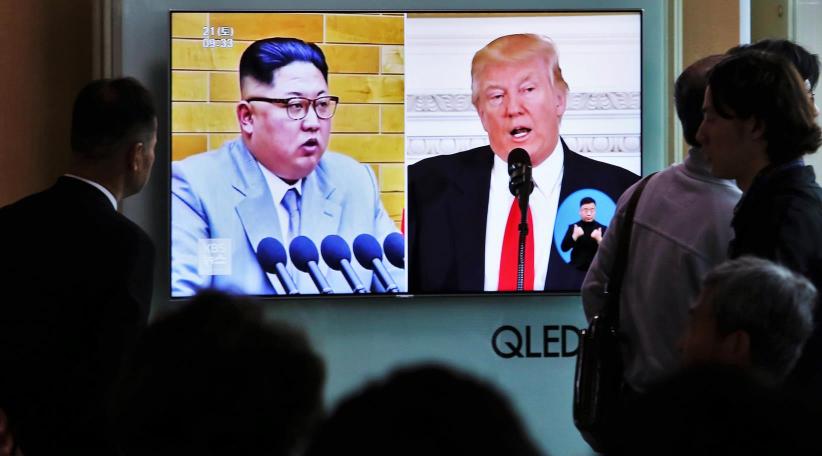
U.S. President Donald Trump on Thursday confirmed that the summit — a first between a sitting U.S. president and a North Korean leader — would take place in Singapore on June 12.
It has one foot in the East and one in the West, is ultramodern, secure and sometimes mocked as being a little dull — Singapore was the safe pick for a historic first meeting between the unpredictable leaders of the U.S. and North Korea.
U.S. President Donald Trump on Thursday confirmed that the summit — a first between a sitting U.S. president and a North Korean leader — would take place in Singapore on June 12.
“We will both try to make it a very special moment for World Peace!” he tweeted.
Singapore also confirmed it would host the meeting, but did not give further details.
“We hope this meeting will advance prospects for peace in the Korean Peninsula,” the country’s Ministry of Foreign Affairs said in a statement late Thursday.
It followed a second visit to Pyongyang by U.S. Secretary of State Mike Pompeo on Wednesday to make arrangements for the summit.
The Southeast Asian financial hub was likely chosen for its neutrality, security advantages and track record of hosting international summits, observers say.
The ultramodern city-state has a robust security infrastructure and is widely considered one of the safest cities in Asia.
It has tight restrictions over media and public gatherings, which will allow for a controlled environment likely to be preferred by the North Koreans.
Single-party rule since Singapore gained independence in 1965 has ensured stability and fostered a security state that is among the world’s most efficient, although sometimes it is decried by civil libertarians as repressive. Located between two Muslim-majority nations — Malaysia and Indonesia — with Islamic State group sympathizers, it has effectively checked terrorist threats.
According to the U.S. State Department’s report on human rights for 2017, Singapore’s “most significant human rights issues” included caning as punishment imposed by the courts; preventive detention under various laws without warrant, filing of charges, or normal judicial review; monitoring private electronic or telephone communications without a warrant; significant restrictions on freedoms of assembly and expression, including for the press and online; the use of defamation laws to discourage criticism; laws and regulations significantly limiting freedom of association; and the criminalization of sexual activities between men, although the law was not enforced.
Singapore is also in the rare position of having friendly diplomatic ties with both Washington and Pyongyang.
It considers the U.S. a close partner, while North Korea maintains a fully functioning embassy in the city-state.
Singapore and the North have a long history of cooperation — the first law firm and fast food restaurant in Pyongyang were both set up by Singaporeans — even if relations hit a snag last year when Singapore enforced new U.N. sanctions on trade.
North Korea’s state companies have, in the past, conducted legal and illegal business dealings with Singapore companies. The city-state, under pressure from the U.S. and a leaked U.N. report, officially cut off trade relations with North Korea in 2017 to abide by sanctions.
Singapore will also be acceptable to China, North Korea’s only major ally, which wields a strong influence despite its physical absence from next month’s proceedings.
“As a neutral, and objective country with much-admired consistent foreign policy principles and a small state with no desire or capacity to harm other states and their interests, Singapore fits that bill well,” said Lim Tai Wei, adjunct research fellow at the National University of Singapore’s East Asia Institute.
By apparently agreeing to meet Trump 5,000 kilometers (3,100 miles) away from Pyongyang, Kim has to travel a significant distance out of his comfort zone, said Graham Ong-Webb, a research fellow at the S. Rajaratnam School of International Studies (RSIS).
Since Kim took over as leader, he has rarely left his isolated nation and has only officially ventured away from home this year, with two visits to China, most recently traveling to the northeastern port city of Dalian where he met Xi Jinping.
He also stepped across the border into South Korea during a historic meeting with President Moon Jae-in in April, making him the first Northern leader to set foot in the South since the Korean War cease-fire in 1953.
Remarkable images of the two leaders greeting each other warmly over the Military Demarcation Line that splits their countries, rich with symbolism and high political theater, were broadcast around the world.
Trump had previously suggested that the demilitarized zone between the two Koreas could be a venue for his meeting with Kim, before ruling it out Wednesday.
Nearby Mongolia was also ruled out as a possible neutral third-country venue, reportedly for security reasons.
But for Trump and Kim, Singapore is a convenient venue precisely because it “doesn’t have the historical or political baggage,” said Sarah Teo, an associate research fellow at RSIS’s regional security architecture program.
Singapore also has a track record for hosting international summits.
In 2015, the city-state played host to a historic meeting between China’s president Xi and then-Taiwanese president Ma Ying-jeou.
It hosts the annual Shangri-La Dialogue, a defense forum regularly attended by heads of state, defense ministers and high-level military officials.
Now that the venue and date have been chosen, it only remains to be seen if Singapore will play host to a meeting that truly builds on hopes for the complete denuclearization of the peninsula and a formal peace treaty to end the 1950-53 Korean War.