- Region:
- World
- Category:
- Politics
G7 Welcomes U.S.-Iran Agreement and Shifts Focus to China, AI and Critical Minerals
-
![G7 Welcomes U.S.-Iran Agreement and Shifts Focus to China, AI and Critical Minerals.]()
G7 Welcomes U.S.-Iran Agreement and Shifts Focus to China, AI and Critical Minerals.
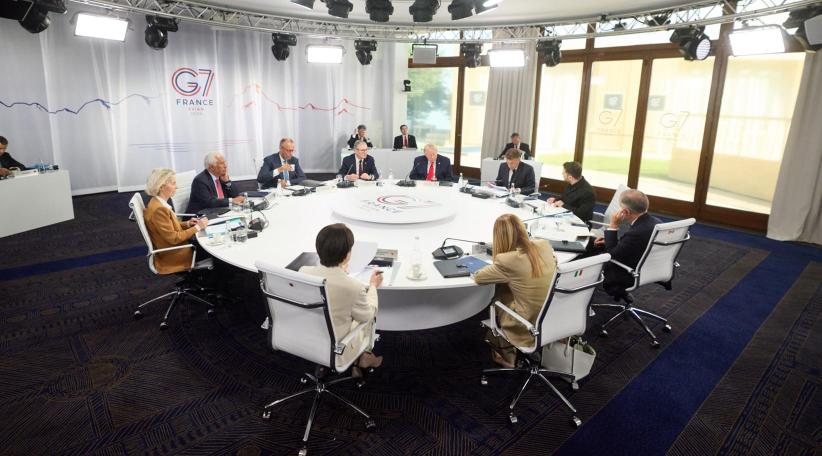
EVIAN-LES-BAINS, France – Leaders of the Group of Seven (G7) welcomed the recent agreement between the United States and Iran aimed at ending months of conflict in the Persian Gulf and reopening the strategically vital Strait of Hormuz, one of the world's most important energy corridors. The development became one of the defining topics of the 2026 G7 Summit in France.
The U.S.-Iran framework agreement is expected to launch negotiations toward a broader settlement while allowing maritime traffic to gradually resume through the Strait of Hormuz, a waterway that normally handles roughly 20% of global oil trade.
Global energy markets responded positively. Oil prices declined sharply after news of the agreement and the reopening process. Shipping data also indicate that several Iranian oil tankers have already resumed transits through the region, carrying millions of barrels of crude oil to international markets and signaling the first tangible steps toward restoring normal energy flows.
U.S. officials said maritime traffic through Hormuz is expected to increase significantly over the coming weeks, although shipping companies continue to monitor security conditions closely as the formal implementation of the agreement moves forward.
With tensions in the Middle East easing, G7 leaders shifted their attention to longer-term strategic challenges. A major focus of the summit has been China's dominance over critical mineral supply chains, including rare earth elements and other materials essential for electric vehicles, semiconductors, renewable energy technologies, and defense systems.
Leaders discussed strategies to diversify supply chains and reduce dependence on Chinese-controlled resources, viewing the issue as both an economic and national security priority.
Artificial intelligence also emerged as a key topic. G7 members discussed proposals that would allow selected “trusted partners” to gain access to advanced U.S. artificial intelligence models despite recent restrictions imposed by Washington on foreign access to some cutting-edge technologies.
The discussions reflect growing efforts among Western allies to strengthen technological cooperation, improve cybersecurity capabilities, and maintain competitiveness in the global AI race, particularly against China.
Additional summit discussions covered Ukraine, global economic imbalances, international trade, and long-term economic resilience.
As the immediate Middle East crisis begins to ease and energy shipments gradually return to normal through the Strait of Hormuz, G7 leaders are increasingly focused on the strategic challenges expected to shape the global economy in the coming decade: energy security, critical minerals, artificial intelligence, and technological competition with China.