- Region:
- World
- Category:
- Tourism
Justin Trudeau at WTTC: “Tourism is the best antidote to a world that is becoming more closed”
-
![Justin Trudeau at WTTC: “Tourism is the best antidote to a world that is becoming more closed”.]()
Justin Trudeau at WTTC: “Tourism is the best antidote to a world that is becoming more closed”.
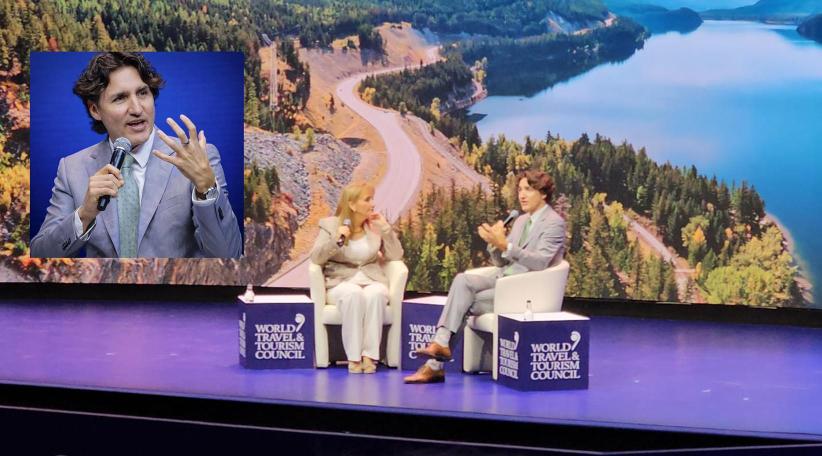
Speaking with WTTC President and CEO Gloria Guevara at the organisation’s Global Summit in Malta, the former Canadian prime minister discussed tourism’s role in diplomacy and job creation, the impact of political tensions on travel between Canada and the United States, his experience strengthening ties with Mexico, and the importance of human connections in an increasingly polarised world.
VALLETTA, Malta — Tourism should not be treated simply as an economic activity or left behind in government priorities. It can create jobs, bring cultures closer together, strengthen diplomatic relationships and encourage societies to remain open to the world. That was one of the central messages delivered by Justin Trudeau, former prime minister of Canada, during a conversation with Gloria Guevara, President and CEO of the World Travel & Tourism Council (WTTC), at the organisation’s Global Summit in Malta.
Held under the theme “FUTU[RE]SET”, the summit brought together international industry leaders to examine the forces reshaping travel and tourism amid technological change, geopolitical uncertainty and evolving traveller expectations. Drawing on his experience leading Canada, Trudeau argued that government decisions, public rhetoric and border policies can have a direct impact on how destinations are perceived.
“Tourism is the best antidote to a world that is becoming more closed,” he said, highlighting the ability of travel to encourage curiosity, build empathy and help people understand lives and perspectives different from their own.
Tourism must have a place at the centre of government policy
Trudeau recalled that when he became prime minister in 2015, he considered it important to give tourism a dedicated place within the government’s ministerial structure. Too often, he argued, governments take the sector for granted, focusing their attention on traditional priorities such as manufacturing or natural resources without fully recognising tourism’s wider economic and social contribution.
His administration invested in infrastructure and international advertising campaigns to promote Canada as a destination. For Trudeau, tourism’s value extends well beyond visitor spending: it supports businesses, creates employment and connects regions and communities.
He particularly emphasised the opportunities it provides for young people. Before entering politics, Trudeau worked as a camp counsellor, whitewater rafting guide, restaurant employee and nightclub bouncer. Those experiences, he explained, helped him develop interpersonal skills, learn conflict resolution and interact with people from different backgrounds.
These early jobs, he suggested, offer more than an income. They help young people build confidence, learn responsibility and acquire skills that remain useful throughout their professional lives.
Mexico: visas as a tool for diplomacy
One of the most significant parts of the discussion focused on Canada’s relationship with Mexico. Trudeau recalled that before he took office, the Canadian government had imposed visa restrictions on Mexican citizens, affecting mobility and creating tensions between the two countries.
During his tenure, he removed those restrictions and made travel easier. He said the decision helped improve bilateral relations and establish a stronger working relationship between Canada and Mexico.
The experience illustrated a broader point: travel requirements are not merely administrative procedures. They can communicate openness or mistrust, shape relations between governments and create conditions for cooperation in other areas.
Trudeau connected the improved bilateral relationship to the wider North American context, including regional trade negotiations. When governments have established channels of communication and a foundation of trust, they are better positioned to manage complex negotiations and address shared interests.
His message was that facilitating travel and treating visitors as potential partners can help build bridges whose benefits extend well beyond tourism itself.
United States and Canada: when political tensions influence travel
Trudeau also discussed how political tensions between the United States and Canada can affect travel decisions. His comments come amid a significant decline in visits by Canadian residents to their southern neighbour.
According to Statistics Canada, Canadian residents made approximately 23.1 million visits to the United States in 2025, down from 30.2 million in 2024 — a decrease of about 23.5%. Meanwhile, visits by Canadians to overseas destinations increased from approximately 12.9 million to 14.3 million.
Trudeau linked this shift to political tensions and to the way travellers perceive how they will be treated when they arrive. Natural beauty, hotel offerings and competitive prices remain important, but they are not always enough. Travellers also want to feel welcome.
A destination’s reputation can be affected by border policies, public messaging and the broader climate of international relations. When visitors are uncertain about how they will be received, they may reconsider their plans and choose another destination.
The issue has important implications for an industry that depends on trust and international mobility. Political decisions can affect airlines, hotels, restaurants, retailers, tour operators and the livelihoods of thousands of people working across the travel ecosystem.
Why face-to-face connections still matter
Another major theme was the importance of meeting in person in an age dominated by digital communication. Trudeau acknowledged that video calls and technology make it easier to maintain relationships and conduct business, but argued that they cannot fully replace face-to-face interaction.
At international gatherings, he observed, some of the most productive conversations do not necessarily take place during formal sessions. They can happen over breakfast, while waiting in line, in a restaurant or during an informal exchange at the end of a long day. These moments allow people to share experiences, build trust and discover common interests.
Travel creates precisely these opportunities: it takes people beyond their familiar surroundings, exposes them to different realities and encourages relationships that may be difficult to develop remotely. In this sense, tourism can help counter isolation, prejudice and growing polarisation.
Leadership means making difficult decisions
Trudeau also reflected on the political costs of leadership. One of his most striking observations was that a leader should enter office with a high approval rating and leave with a lower one. His point was that governing cannot simply be about making popular decisions; it also requires confronting difficult choices that may be necessary in the long term.
Among the achievements of his administration, he highlighted Canada’s ten-dollar-a-day childcare programme, designed to reduce costs for families, support parents’ participation in the workforce and strengthen early childhood development. He also stressed the importance of recognising and professionalising the work of childcare and early education workers.
Looking back at the most difficult moments of his time in office, Trudeau addressed misinformation during the COVID-19 pandemic. He said false information discouraged some people from getting vaccinated, contributed to serious consequences and deepened social divisions that continue to affect communities. For the former prime minister, the experience demonstrated how the erosion of trust and the spread of misleading information can have consequences far beyond political debate.
A message for tourism’s future
The conversation ended with Trudeau recommending Montreal, his hometown, for its restaurants, art, summer festivals and snowy winters. Yet his broader point was that a destination’s appeal cannot be measured by landscapes and attractions alone. The people visitors meet are an essential part of the experience.
His message in Malta offered both a warning and an opportunity for the travel industry. Tourism can be a major economic driver, but its impact also depends on government decisions, openness to the world and the ability to build trust.
At a time when political and cultural divisions appear to be hardening, travel remains a practical way to bring people closer together. For Trudeau, that is precisely why tourism matters: it allows people to encounter one another directly and recognise that differences do not have to become barriers.