- Region:
- Europe
- Category:
- Characters
- Article type:
- Approaches
Giorgio Armani, the king of a vast and democratic empire that recognizes no social hierarchies
-
![Giorgio Armani, the king of a vast and democratic empire that recognizes no social hierarchies]()
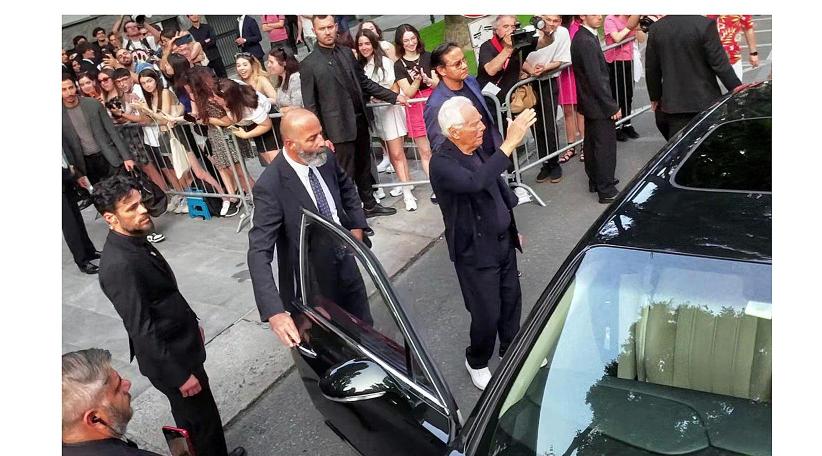
Photo de Pablo Munini - Emporio Armani fashion show 2023 Giorgio Armani, the king of a vast and democratic empire that recognizes no social hierarchies
- Region:
- Europe
- Category:
- Characters
- Article type:
- Approaches
- Author/s:
- Publication date:
It happened on a Saturday afternoon many years ago. I suggested to a friend visiting me in Milan that we walk from Piazza San Babila along one of King Giorgio’s favorite streets: Via Montenapoleone.
After just 50 meters, we crossed paths with Giorgio Armani himself, walking accompanied only by a bodyguard. No one dared to bother him on his way; it was the presence at the same time of a humble and anonymous Milanese resident and the absolute king of fashion of all time and of the city of Milan.
Another time, I saw him enter his restaurant, Nobu, at night; he waved from a distance to everyone working at the bar, whom he could have ignored while heading to the main dining area.
Giorgio, the king, the emperor. That was and always will be Armani: a popular king, the emblem of a city, of the world’s fashion capital.
Those who knew him closely say he was a handsome man: blue eyes, completely white hair, always tanned, always in a fitted t-shirt or a tuxedo; there was no other option. He dressed with discreet and minimalist elegance.
I’ve always noticed, after returning from a trip, that the first thing I see is the Armani logo somewhere: on airport lights, on a huge billboard, or identifying the jeans of anyone walking by.
Armani was born in Piacenza, but he was Milanese par excellence; he knew how to distinguish and give meaning to every street in Milan. Deeply Milanese, he turned Milan into a global symbol, the very center of his existence and his world.
Armani internationalized the city that adopted him, and for this reason he was never seen by other fashion greats as a rival, but as a figure above all, who defended Italian design and fashion to the extreme.
For him, fashion was not just fashion: it was cinema, music, sport, art, design, and architecture, leaving his mark in all these worlds and everywhere he went, said Anna Wintour, global head of Vogue and the inspiration for the main character in The Devil Wears Prada:
"Life is a movie, and my garments are the wardrobe."
The starting point of this personal vision of Armani began with American Gigolo, then moved to actors in Brian De Palma or Martin Scorsese films, to the likes of Robert De Niro, Ray Liotta, or Joe Pesci, or the film The Wolf of Wall Street (2013), with Leonardo DiCaprio as a “money-hungry broker” wearing Armani suits.
"The sexiest man on the planet wears Armani," US newspapers proclaimed when Brad Pitt, in Inglourious Basterds, shone in an ivory tuxedo, mother-of-pearl cufflinks, and a red carnation on the lapel.
Maria Luisa Frisa, art historian and fashion theorist, summarizes a thought that, after Giorgio Armani’s death, becomes increasingly clear: the designer, recognized for rigorous lines and sober elegance, was in fact a great innovator.
"He was the first to conceive a fashion in which men and women could be recognized equally."
Armani dressed modernity. In the 1980s, he empowered women who needed jackets with strong shoulders to assert themselves in offices and companies, not just as assistants or secretaries, but as protagonists. At the same time, he softened the male jacket just when men were learning to declare their homosexuality, accepting themselves as objects of desire on the same level as women.
At the core was always the idea of movement: garments that dance in harmony with the body. Just think of Richard Gere in American Gigolo: he walks, and the suit moves with him; the open shirt reveals his smooth chest, symbolizing a new, free, and sensual masculinity.
Armani dressed Julia Roberts, Diane Keaton, Beyoncé, Anne Hathaway, Lady Gaga, Angelina Jolie, Cate Blanchett, Nicole Kidman, Mariah Carey, Jodie Foster, Margot Robbie, George Clooney, Richard Gere, Michael Keaton, Pierce Brosnan… the list could be endless.
Armani was also the designer par excellence for royalty. Charlene of Monaco chose a gown designed by Giorgio Armani for her wedding, with an elegant minimalist cut and 40,000 Swarovski crystals.
But I can go further: I bet there is no one in Italy who doesn’t have in their wardrobe, past or present, a tailleur, a shirt, a jacket, a t-shirt, a tie, or at least an Armani accessory.
Giorgio, the king, personified himself in every citizen of his vast and democratic empire that recognizes no social hierarchies.