- Region:
- World
- Category:
- Politics
U.S. sanctions Venezuela and 14 nations limit diplomatic ties after Maduro claims win
-
![Lima Group Refuses to Accept Maduro Victory in Venezuela Election]()
The Lima Group is comprised of Argentina, Brazil, Canada, Chile, Colombia, Costa Rica, Guatemala, Guyana, Honduras, Mexico, Panama, Paraguay, Peru and Saint Lucia. Lima Group Refuses to Accept Maduro Victory in Venezuela Election
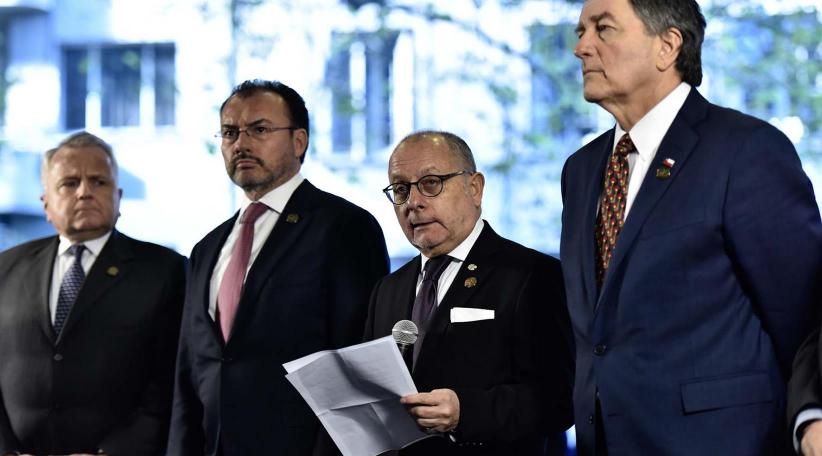
While the Lima Group did not announce immediate sanctions, it said it would lobby international lenders not to offer loans to Venezuela that did not have prior approval from the opposition-held National Assembly.
In a statement, the Lima Group said its members did not recognize the “legitimacy” of the vote, had agreed to “reduce the level of diplomatic relations with Venezuela” and were recalling their ambassadors for consultation.
The Lima Group is comprised of Argentina, Brazil, Canada, Chile, Colombia, Costa Rica, Guatemala, Guyana, Honduras, Mexico, Panama, Paraguay, Peru and Saint Lucia.
U.S. Sen. Marco Rubio, R-FL., applauded the new White House sanctions and called on Venezuelan political leaders to remove Maduro.
“Nicolás Maduro told his supporters that pulling off a fake election would be a reset that would result in less sanctions and less isolation,” Rubio said in a statement. “Instead, he faces more sanctions and is more isolated than ever. Maduro’s days in power are numbered.”
While the Lima Group did not announce immediate sanctions, it said it would lobby international lenders not to offer loans to Venezuela that did not have prior approval from the opposition-held National Assembly.
That could be a serious blow for the cash-strapped nation that needs external funding to import food and medicine.
Maduro and his allies have sidelined the National Assembly, which was elected in 2015, and have allowed a new super-body, the National Constituent Assembly, to usurp most of its functions.
In addition, the Lima Group said it would “intensify and broaden” the exchange of financial information to identify Venezuelan companies and individuals “who could be involved in acts of corruption, money laundering and other illicit activity.”
Monday’s actions are likely just the first wave of more sanctions, said Francisco Monaldi, with the Baker Institute,
a nonpartisan public policy think tank at Rice University.
“I expect that in the next few days and weeks, we will continue seeing the number of countries that have not recognized these elections in the Western Hemisphere and Europe tightening sanctions and making it harder for the Venezuelan government to keep [behaving] the way they have been behaving,” he told a conference held by the Atlantic Council in Washington, D.C.