- Region:
- World
- Category:
- Technology
Artemis II Leaves Earth Orbit and Begins Historic Journey to the Moon
![Artemis II Leaves Earth Orbit and Begins Historic Journey to the Moon.]()
Artemis II Leaves Earth Orbit and Begins Historic Journey to the Moon.
- Region:
- World
- Category:
- Technology
- Author/s:
- Publication date:
NASA’s Artemis II mission is now officially on its way to the Moon after the Orion spacecraft successfully completed the critical translunar injection burn, placing the crew on a trajectory toward lunar orbit and marking humanity’s return to deep space for the first time since 1972.
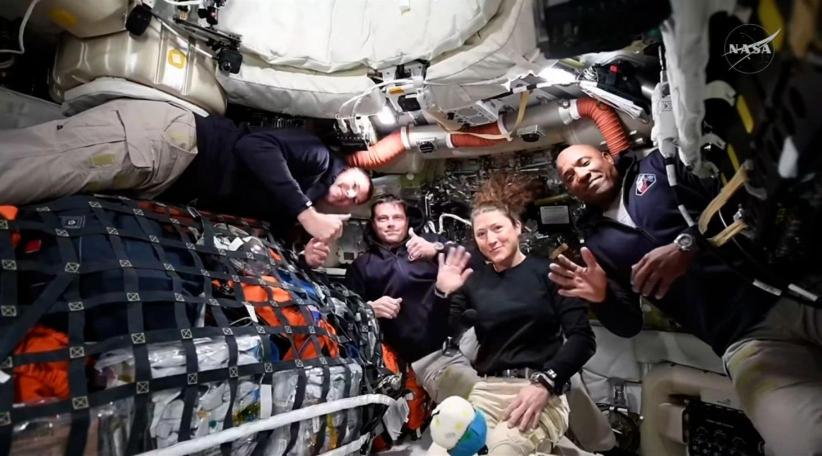
The approximately six-minute engine firing, carried out Thursday by Orion’s service module, allowed the spacecraft to break free from Earth’s orbit and begin its outbound journey. Aboard Orion are NASA astronauts Reid Wiseman, Victor Glover, Christina Koch and Canadian Space Agency astronaut Jeremy Hansen.
“This is the first time since Apollo 17 in 1972 that humans have departed Earth orbit,” said Dr. Lori Glaze, acting associate administrator for NASA’s Exploration Systems Development Mission Directorate. She emphasized that Orion is operating with a crew in space for the first time and that every phase of the mission is providing valuable data for future lunar exploration.
The mission began on April 1, when NASA’s Space Launch System rocket and the Orion spacecraft lifted off from Kennedy Space Center Launch Complex 39B. The four astronauts are expected to spend 10 days in space, traveling around the Moon and returning to Earth.
Shortly after launch, Orion deployed its four solar array wings and entered an elliptical orbit around Earth. A second burn then placed the spacecraft into a high Earth orbit extending about 46,000 miles above the planet, where the crew conducted system checks and manual piloting exercises. The astronauts also tested Orion’s handling by maneuvering the spacecraft near the rocket stage that launched them.
The crew named the spacecraft “Integrity.” After separating from the upper stage, Orion safely moved away while the discarded rocket stage re-entered Earth’s atmosphere over the Pacific Ocean. Before re-entry, four small CubeSats were released to carry out additional scientific and technology missions.
NASA reported that the astronauts have already completed their first sleep periods, adapted to microgravity, carried out the first onboard exercise session and restored Orion’s toilet system to normal operation. Wiseman became the first crew member to use the spacecraft’s flywheel exercise device, designed to preserve muscle and bone strength during the journey.
Inside Orion, the astronauts are living in a compact environment roughly comparable to a camper van. The capsule includes sleeping areas, a privacy-equipped restroom, a food warmer and laptops and tablets for work and leisure during the mission.
According to current projections, Artemis II could reach a maximum distance of 252,021 miles from Earth — more than 405,000 kilometers — surpassing the record set by Apollo 13 mission and becoming the farthest human spaceflight ever conducted.
During a planned lunar flyby on April 6, the crew will photograph the Moon and observe regions of its far side never directly seen by humans. Although the far side will be only partially illuminated, NASA expects the lighting conditions to highlight ridges, craters and slopes in exceptional detail.
Following the lunar flyby, Orion will begin its journey back to Earth and is scheduled to splash down in the Pacific Ocean off the coast of San Diego.