- Region:
- Europe
- Category:
- Business
EICMA 2026: European motorcycle industry warns of Asian competition and calls for fairer rules to protect its future
-
![EICMA 2026: European motorcycle industry warns of Asian competition and calls for fairer rules to protect its future.]()
photo: PABLO MUNINI. EICMA 2026: European motorcycle industry warns of Asian competition and calls for fairer rules to protect its future.
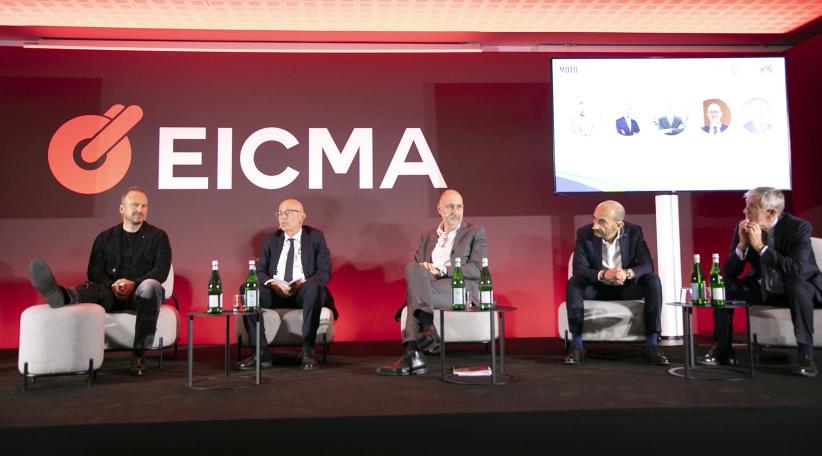
At the international conference Motonomics, held during EICMA 2026 in Milan, representatives of ANCMA, ACEM, BMW Motorrad and Ducati called for industrial policies, regulatory predictability and investment in innovation. An Oxford Economics study highlighted the sector's economic and employment contribution, while industry leaders warned about growing trade imbalances with Asia.
MILAN, Italy – Europe's motorcycle industry needs a coordinated industrial and political strategy to compete on fairer terms against the growing strength of Asian manufacturers. This was one of the main messages of the international conference "Motonomics: Industrial Realities and Policy Horizons," held as part of EICMA 2026 at Fiera Milano Rho.
Organized in collaboration with Confindustria ANCMA and ACEM (the European Association of Motorcycle Manufacturers), the event brought together industry leaders to discuss the economic, commercial, technological and regulatory challenges shaping the sector's future.
Opening the conference, Fabrizio Casellato, Director General of Confindustria ANCMA, highlighted EICMA's role as an international platform for anticipating trends and engaging directly with policymakers. He warned about intensifying global competition, geopolitical tensions and environmental requirements, calling for clear regulations, realistic implementation timelines and fair trade conditions.
Casellato presented positive European market figures. During the first half of 2026, new motorcycle registrations across Italy, France, Germany, Spain and the United Kingdom exceeded 636,000 units, an increase of 16.8% year-on-year. Italy alone recorded more than 220,000 registrations, up 13.2%.
He also highlighted the importance of Italy's motorcycle value chain, which generates approximately €9 billion in turnover, produces more than 381,000 vehicles and directly employs around 36,000 people. Including indirect employment, the figure exceeds 85,000.
ACEM: motorcycles as part of the mobility solution
Markus Flasch, ACEM President and CEO of BMW Motorrad, explained that the industry encompasses an extensive value chain, including manufacturers, suppliers, dealerships, repair shops, riding schools and tourism operators.
He noted that demand for individual and open-air mobility, which increased during the pandemic, has remained strong. Registrations in Europe's largest markets are now more than 15% above 2019 levels.
Flasch also highlighted opportunities created by expanding low-emission urban zones and rising car prices and ownership costs, which favor smaller and lighter vehicles. In this context, motorcycles can contribute to both passenger mobility and urban logistics.
Antonio Perlot, ACEM Secretary General, presented the main objectives of a new Oxford Economics study examining the European motorcycle industry's economic contribution, its position in international trade and the benefits motorcycles bring to users and cities. He also warned about supply chain vulnerabilities resulting from geopolitical tensions and dependence on components manufactured in unstable regions.
Ducati calls for fairer competitive conditions
Antonio Erario, Head of Division at Italy's Ministry of Infrastructure and Transport, emphasized the need for predictable regulations adapted to the specific characteristics of the motorcycle industry, rather than automatically applying the same requirements as those used in the automotive sector. He also highlighted motorcycles' contribution to urban mobility and logistics.
One of the strongest interventions came from Claudio Domenicali, ACEM Vice President and President and CEO of Ducati. He warned that maintaining Europe's current industrial structure will become practically impossible unless international competitive conditions change.
Using a football analogy, Domenicali described the imbalance between European manufacturers and competitors operating under different trade and regulatory rules. He also questioned preferential trade conditions granted to certain countries that, despite their technological and industrial development, continue to benefit from favorable market access.
Mariano Roman: innovation and investment for Europe's future
Closing the conference, Mariano Roman, President of Confindustria ANCMA, stated that Asia accounts for approximately 75% of the global motorcycle market and benefits from advantages in production costs, manufacturing volumes, taxation and government support.
Roman argued that Europe should strengthen its position in the high-end motorcycle segment, but stressed that this requires a coordinated strategy between businesses and governments. He called for simpler taxation, greater investment in research and development, and dedicated European funding to support technological innovation.
His final warning was that without these measures, Europe will struggle to remain competitive and protect the approximately 400,000 jobs linked to the European two-wheel industry.
The conference delivered a clear message: motorcycles represent far more than an industrial product. They are part of a strategic value chain that generates employment, exports, innovation and sustainable mobility. Europe's ability to protect and develop this industry will depend not only on manufacturers, but also on the political and economic decisions made in the coming years.