- Region:
- Asia
- Category:
- Politics
The Republic of China (Taiwan) is celebrating its 109th National Day
-
![The Republic of China (Taiwan) is celebrating its 109th National Day]()
Double Ten Day National Day The Republic of China (Taiwan) is celebrating its 109th National Day
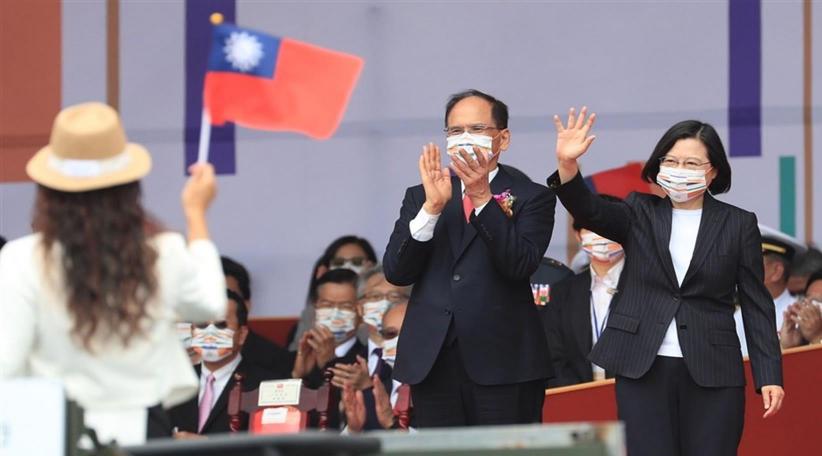
Tsai lays out economic development strategies on National Day.
President's remarks on China ties draw mixed response from scholars.
President Tsai Ing-wen (蔡英文) on Saturday said in her National Day speech that the government will pursue three major strategies to boost the local economy as Taiwan is doing better than many other countries in fighting COVID-19.
"Because the pandemic was properly controlled, Taiwan became one of the few countries in the world that maintained positive economic growth," Tsai said in the speech.
"We have also prepared for economic development in the post-pandemic era," Tsai said, referring to the six core strategic industries she announced earlier this year, such as the Internet of Things/artificial intelligence, information security, biotech applications, national defense and renewable energy development.
Tsai also said the government will continue to push for the Forward-looking Infrastructure Development Program, which covers a wide range of aspects, including rail transport construction, water improvement, digital development, urban and rural development, child care environment improvement, and food safety improvement.
In the speech, Tsai laid out three major strategies to facilitate the growth of the local economy as Taiwan is determined to steam ahead economically amid the fading impact from the pandemic.
First of all, Tsai said, at a time when global supply chains have been in a process of restructuring, Taiwan will fully take part in the reorganization.
"The rapid dismantling and realignment of global supply chains is now irreversible, and Taiwanese businesses around the world are moving toward segmented markets, production base migration, and reshoring to invest in Taiwan at an ever-faster pace," Tsai said.
"We will link all of these related policies and programs while integrating government and private sector resources with cross-department capabilities to achieve full and comprehensive participation in the realignment process, making Taiwan an indispensable force in global supply chains," Tsai said.
Secondly, Tsai said, Taiwan will transform itself into a hub for international capital, talent, and digital technology, adding the efforts for such an upgrade is critical for Taiwan to participate in the global supply chain reorganization.
"We will continue to deepen reforms and eliminate obstacles to create an environment and legal structure to attract international capital and talent," Tsai said. "We will also actively cultivate domestic industrial talent through international exchanges, industry-academia cooperation, and a bilingual nation policy."
Third, Tsai said the government will do its best to reach a balance between economic and social development to get rid of possible risks caused by unbalanced development as well as likely repercussions resulting from a massive increase in capital supply.
"The government will therefore put greater emphasis on the reasonable distribution of resources, take care of the disadvantaged affected by our economic transformation, strengthen and spur youth employment, and encourage and effectively utilize funding to bring back Taiwan's economic growth dividend for everyone to share," Tsai said.
According to Tsai, under the government's policy which started in January 2019 to provide incentives to encourage Taiwanese investors with overseas operations to return home for investments, firms have pledged to invest more than NT$1 trillion (US$34.48 billion) in Taiwan.
Tsai said an additional NT$100 billion are expected to come in, while many multinational companies planning to pour funds into Taiwan as well.
Meanwhile, Tsai touted the government's efforts in international economic cooperation, citing the signing of a Framework to Strengthen Infrastructure Finance and Market Building Cooperation between Taiwan and the United States last week.
Under the agreement, Taiwan is expected to jointly participate in infrastructure projects in the Americas and the Indo-Pacific region, Tsai said.
Tsai said Taiwan and the U.S. will hold a high-level economic dialogue to identify future cooperation opportunities in realignment of global supply chains, technological cooperation and infrastructure among many aspects.
President's remarks on China ties draw mixed response from scholars:
Scholars from Taiwan and China had differing opinions Saturday on President Tsai Ing-wen's (蔡英文) National Day address, with some praising her effort to maintain stability in cross-strait relations, while others remained skeptical on whether it was enough to convince Beijing to restart dialogue.
Tsai, who expressed willingness to hold "meaningful dialogue" with the leadership of Beijing, sent a message indicating her wish to help maintain peaceful Taiwan-China relations through high-level talks, so long as parity and dignity are assured, said Chao Chun-shan (趙春山), a professor emeritus from the Institute of China Studies at Tamkang University in Taipei.
Tsai also exercised restraint by not highlighting recent growing Taiwan-U.S. relations in her speech, to avoid angering Beijing, Chao said.
Tsai's remarks that "we will not act rashly and will uphold our principles" on Taiwan-China ties makes clear her determination to maintain stability in cross-strait relations, he said.
Tamkang University Graduate Institute of China Studies associate professor Chang Wu-ueh (張五岳) also said that Tsai's speech showed her consistency in cross-strait policies, despite uncertainties in U.S.-China and India-China relations.
In addition, Tsai might want to create opportunities for peaceful dialogue with Beijing, evident in her echoing of China's video message to the United Nations General Assembly that Beijing will never seek hegemony, expansion or a sphere of influence, Chang said.
Tsai said in her speech that she is aware of China's remarks and that "as countries in the region and around the world are now concerned about China's expanding hegemony, we hope this is the beginning of genuine change."
However, one Chinese scholar held an opposite view toward the comment, arguing that Tsai had missed the point.
Liu Guosheng (劉國深), a cross-strait relations expert at Xiamen University, said Tsai's using of the words "hegemony" and "concerned" in her address looked to him like indirect rebukes to China.
Her Democratic Progressive Party (DPP) administration must recognize that "both sides of the Taiwan Strait belong to the same country" with sincerity and courage so that it may understand Beijing's position, he said.
Alexander Huang (黃介正), a strategic studies professor at Tamkang University, said Tsai did not show weakness or attempt to cozy up to China in her speech, but expressed her intention to hold healthy conversation with Beijing and maintain peaceful ties.
It could be "relatively difficult" for Beijing to accept this, though, considering the current situation, Huang said.
The two sides must accumulate goodwill and restore mutual trust, and one of the priorities at the current stage is refraining from making meaningless and provocative comments toward each other, he said.
In response to Tsai's address, Zhu Fenglian (朱鳳蓮), spokesperson of China's Taiwan Affairs Office, said in a statement later Saturday that it showed Taiwan's continuation of hostility.
Zhu urged the DPP to abandon its Taiwan independence agenda, describing it as a "dead-end" and that only by returning to the "1992 consensus" could there be mutual dialogue and improvement in ties.
The "1992 consensus" is a tacit agreement that was reached in 1992 by officials of the then-ruling Kuomintang government and the Communist Party of China at a meeting in Hong Kong. It agrees that there is only "one China," with each side free to interpret what that means, an idea that is firmly rejected by the DPP.