- Region:
- USA
- Category:
- Politics
Trump knew Covid was deadly but wanted to ‘play it down’, Woodward book says
-
![Trump knew Covid was deadly but wanted to ‘play it down’, Woodward book says]()
Trump knew Covid was deadly but wanted to ‘play it down’, Woodward book says
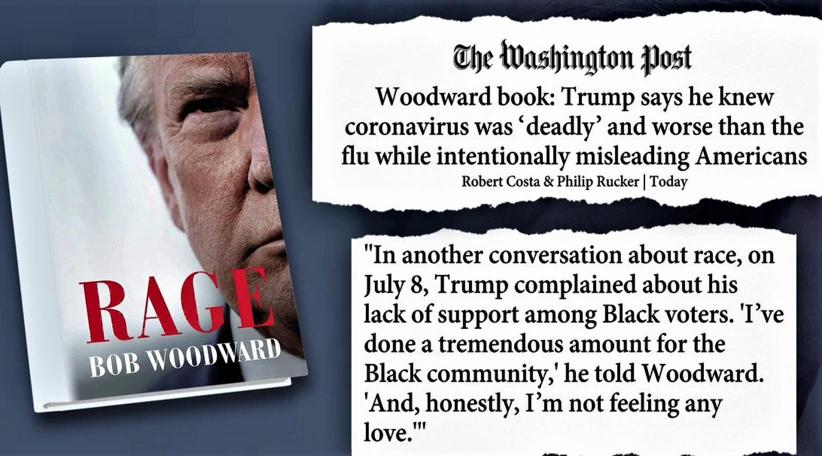
US president gave Bob Woodward 18 interviews, forming basis of new book Rage, and said of virus: ‘This is deadly stuff’
Donald Trump knew the extent of the deadly coronavirus threat in February but intentionally misled the public by deciding to “play it down”, according to interviews recorded by one of America’s most venerated investigative journalists.
The US president gave Bob Woodward 18 interviews between December 2019 and July 2020. They form the basis of his revelatory new book, Rage, obtained on Wednesday by the Washington Post and CNN, in which Trump is condemned by his own words.
Just two months before he seeks re-election, Trump is quoted describing former president George W Bush as “a stupid moron” and mocking the Black Lives Matter movement for racial equality and an end to police brutality.
The book also reports that the US may have come close to nuclear war with North Korea in 2017.
Rage displays the chasm between Trump’s public and private statements on the Covid-19 pandemic, which has killed more than 190,000 Americans and caused the worst economic crisis since the Great Depression.
As early as 28 January 2020, Robert O’Brien, the national security adviser, gave him a “jarring” warning, informing the president that Covid-19 would be the “biggest national security threat” of his presidency. Trump’s head “popped up”, the book says.
Three days later, Trump announced restrictions on travel from China, although the virus was already in the United States.
On 7 February he told Woodward in a phone call: “It goes through the air. That’s always tougher than the touch. You don’t have to touch things. Right? But the air, you just breathe the air and that’s how it’s passed. And so that’s a very tricky one. That’s a very delicate one. It’s also more deadly than even your strenuous flus.”
He added: “This is deadly stuff.”
But February, in the view of Woodward and many other analysts, was a wasted month. On 27 February, Trump said publicly: “It’s going to disappear. One day – it’s like a miracle – it will disappear.” In a tweet on 9 March, he explicitly compared it to the common flu, noting that “Nothing is shut down, life & the economy go on” in flu season. “Think about that!”
By 19 March, Trump had declared a national emergency but told Woodward: “I wanted to always play it down. I still like playing it down, because I don’t want to create a panic.”
At the White House on Wednesday, Trump dismissed the book as “just another political hit job” and sought to defend his handling of the pandemic.
He added: “And certainly I’m not going to drive this country or the world into a frenzy. We wanna show confidence, we wanna show strength as a nation, and that’s what I’ve done. And we’ve done very well from any standard. You look at our numbers compared to other countries, other parts of the world, it’s an amazing job that we’ve done.”
America has the highest caseload (6.35m infections) and highest death toll (190,815) in the world, according to Johns Hopkins university figures. It also has one of the highest fatality rates per 100,000 population, at 57.97.
Later, Trump told Fox News: “I said don’t panic. I’m a cheerleader for this country and I don’t want to see panic.”
Speaking at an election campaign event in Warren, Michigan, on Wednesday afternoon, the Democratic presidential candidate, Joe Biden, reacted to the reports by saying: “He knew how deadly it was. It was much more deadly than the flu. He knew and purposely played it down. Worse, he lied to the American people. He knowingly and willingly lied about the threat it posed to the country for months.”
Biden added: “He had the information. He knew how dangerous it was and, while this deadly disease ripped through our nation, he failed to do his job on purpose. It was a life and death betrayal of the American people. Experts say that if he’d acted just one week sooner, 36,000 people would have been saved.”
Nancy Pelosi, the Democratic House speaker, told the MSNBC network: “I think what he said connotes two things. One, his weakness: he didn’t know how to cope with the challenge to our country.
“Secondly, his disdain and denial for science, which has the answers, we could have contained this early on. But bigger than all of that was his total disregard for the impact on individual families in our country.”
At a White House coronavirus taskforce briefing on 3 April, Trump was still minimising the virus.
“I said it’s going away and it is going away, ” he said. But just two days later, he told Woodward: “It’s a horrible thing. It’s unbelievable.” On 13 April, he acknowledged: “It’s so easily transmissible, you wouldn’t even believe it.”