- Region:
- USA
- Category:
- Technology
Samsung shakes up CES 2026 with the Galaxy Z TriFold: a tablet-sized screen that fits in your pocket
![Samsung shakes up CES 2026 with the Galaxy Z TriFold: a tablet-sized screen that fits in your pocket.]()
Samsung shakes up CES 2026 with the Galaxy Z TriFold: a tablet-sized screen that fits in your pocket.
- Region:
- USA
- Category:
- Technology
- Publication date:
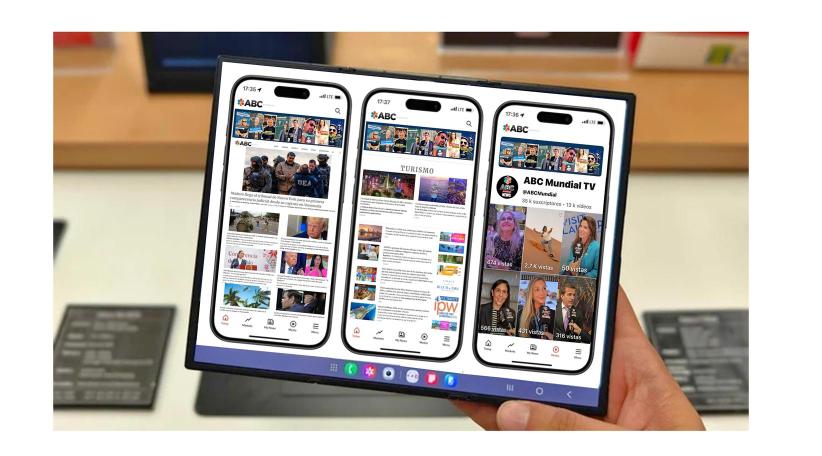
Las Vegas — CES 2026. Samsung once again set the pace of technological innovation at the Consumer Electronics Show (CES) 2026 with the unveiling of the Galaxy Z TriFold, a smartphone that folds at two points — like a brochure — and, when fully unfolded, delivers a 10-inch display comparable to that of an iPad-sized tablet.
The device was shown to the press during the Samsung Electronics First Look event, ahead of its launch in the United States, following an initial and limited release in South Korea. With this announcement, the world’s largest smartphone manufacturer reinforces its commitment to redefining the future of mobile devices, even if the product is not yet aimed at the mass market.
The Galaxy Z TriFold represents a direct evolution of the Galaxy Z Fold lineup, but pushes the concept one step further. While the Galaxy Z Fold 7 folds in half and offers an 8-inch display, the new model incorporates two hinges that transform the device into a truly portable giant screen.
Productivity at the core
Samsung positions the TriFold as a device designed for professional users and productivity-focused workflows. Its expansive display allows multiple applications to run in split-screen mode and, unlike most smartphones, operates more like a computer: apps appear as resizable windows that can be freely moved across the screen.
Paired with a Bluetooth keyboard and mouse, the Galaxy Z TriFold can become a genuine alternative to a mini laptop — a proposition Samsung strengthens with the integration of Google’s Gemini assistant, capable of responding to queries that involve several apps open simultaneously.
Bold design, inevitable trade-offs
The visual impact of the TriFold is undeniable. When opened, it is remarkably thin, almost paper-like. When closed, however, it becomes bulky, with a thickness comparable to two stacked smartphones — one of the main compromises of this form factor.
Although an official price has not yet been confirmed, the market widely expects it to be an ultra-premium device. As a reference, the Galaxy Z Fold 7 starts at around USD 2,000, suggesting that the TriFold will be beyond the reach of the average consumer.
Advancements over previous generations
Unlike early foldable smartphones, the Galaxy Z TriFold demonstrates greater technological maturity. Its cameras are on par with Samsung’s premium models, such as the Galaxy S25 Ultra, eliminating one of the major trade-offs that characterized the first generations of foldables.
While the two screen creases remain visible, their impact is reduced and does not significantly interfere with the user experience — a notable improvement compared to earlier models.
More experiment than revolution — for now
Despite its technological prowess, the Galaxy Z TriFold does not yet offer a compelling justification for mainstream consumers. Beyond enabling more content viewing, multitasking, and an expanded visual experience, it does not introduce a truly disruptive function that cannot — to some extent — be achieved with existing foldable or traditional smartphones.
That, however, does not appear to be Samsung’s immediate priority. Industry analysts agree that the TriFold functions as a strategic pilot project, designed to explore how consumers interact with new formats and to push the boundaries of mobile design.
Samsung’s message at CES 2026
With this unveiling, Samsung made it clear at CES 2026 that smartphones have not yet reached their evolutionary ceiling. In a mature and saturated market, the company is betting on diversified form factors, experimentation, and leadership in the technological conversation — even knowing that not every product will become an immediate commercial success.
In a landscape where foldable phones still represent a small share of the global market — and where Apple is reportedly preparing its first foldable device — the Galaxy Z TriFold stands as a statement of intent: the future of the smartphone will be flexible, hybrid, and increasingly closer to a portable computer.