- Region:
- USA
- Category:
- Tourism
Geoff Freeman: U.S. travel industry targets 100 million international visitors by 2030
-
![Geoff Freeman: U.S. travel industry targets 100 million international visitors by 2030.]()
Geoff Freeman: U.S. travel industry targets 100 million international visitors by 2030.
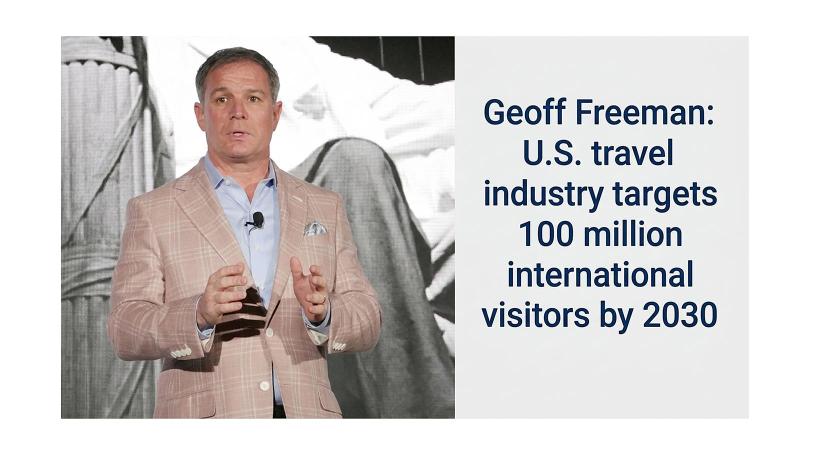
U.S. Travel Association CEO Geoff Freeman discussed the future of American tourism, the impact of the 2026 FIFA World Cup and America 250 celebrations, luxury travel and his recent meeting with President Donald Trump.
The U.S. travel industry is looking to turn the momentum generated by the 2026 FIFA World Cup and the celebration of America's 250th anniversary into sustained international tourism growth.
That was one of the central themes addressed by Geoff Freeman, president and CEO of the U.S. Travel Association, during a wide-ranging interview on RMWorldTravel broadcast on September 12. Freeman discussed the current state of the travel industry, the economic opportunities created by major events and his recent meeting with President Donald Trump at the White House.
During the September 2 White House meeting with Trump and executives from major airlines, hotel companies, cruise operators and travel businesses, Freeman outlined an ambitious goal for the industry: attracting 100 million international visitors annually to the United States by 2030.
Freeman pointed to the country's previous record of nearly 80 million international visitors in 2018 and argued that the United States now has an opportunity to significantly exceed that figure. He also said the industry wants to help make the U.S. the world's most visited country, a position currently held by France.
The goal comes amid a mixed tourism environment. Reuters reported that international arrivals to the United States were down 4.7% through July 2026, despite a temporary boost from the FIFA World Cup. Industry leaders have raised concerns about visa processing times, airfare costs and immigration policies that could discourage international travelers.
At the same time, major events have demonstrated the economic power of travel. The World Cup and America 250 brought visitors to cities and destinations across the country, benefiting airlines, hotels, restaurants, attractions, retailers and local businesses.
Travel spending also showed strong momentum. According to figures cited by Reuters, U.S. travel spending reached $122.1 billion in June, up 6.2% from a year earlier, as the World Cup got underway.
Freeman also highlighted the continued strength of the luxury travel sector, which remains an important component of the U.S. tourism economy. Demand for premium hotels, high-end experiences, luxury cruises, fine dining and personalized travel continues to attract affluent international and domestic travelers.
The next challenge for the industry is converting the extraordinary visibility generated by 2026 into long-term growth. U.S. Travel Association is seeking closer cooperation among government agencies, airlines, hotels, destinations and other travel businesses to make international travel to the United States easier and more competitive.
For Freeman, the objective is clear: build on the momentum of the World Cup and America 250, address barriers to international travel and position the United States to reach 100 million international visitors a year by 2030.
The ambition would not only strengthen the travel industry but also reinforce tourism's role as a major driver of economic activity across the country.