- Region:
- America
- Category:
- Politics
Tension in Venezuela: Maduro and the Opposition Both Claim Victory in Presidential Elections
-
![Tension in Venezuela: Maduro and the Opposition Both Claim Victory in Presidential Elections]()
Tension in Venezuela: Maduro and the Opposition Both Claim Victory in Presidential Elections
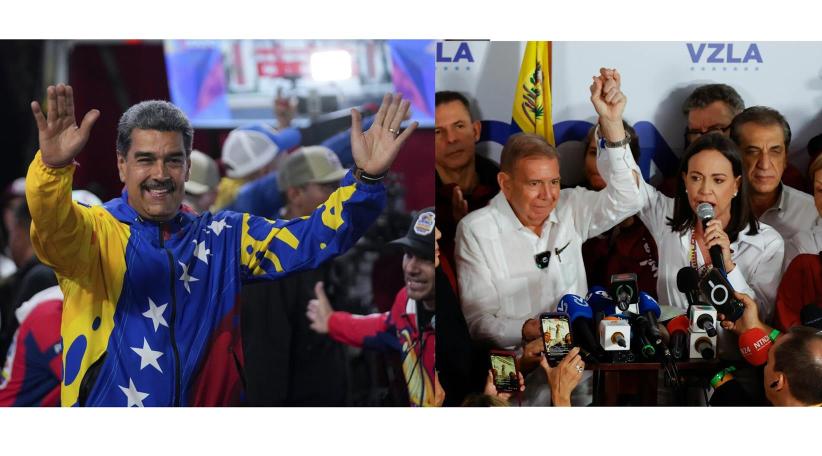
Caracas - The recent presidential election in Venezuela has created an atmosphere of tension and controversy. The National Electoral Council (CNE) declared Nicolás Maduro the re-elected president with 51.2% of the votes, while the opposition, led by María Corina Machado, claims that the true winner is former ambassador Edmundo González Urrutia, who allegedly received 70% of the votes.
Maduro, who has been in power since 2013, addressed his supporters near the presidential palace after being declared the winner by the CNE. In his speech, he called for "respect for the popular will" and promised to defend the constitution, public powers, and Venezuela's sovereignty. The president pledged to work in his third term to "recover all the rights violated by the economic war," referring to the sanctions imposed by various countries, especially the United States.
Elvis Amoroso, president of the CNE, announced the results six hours after the polling stations closed, indicating that with 80% of the votes counted, Maduro had received 5,150,092 votes, representing 51.20% of the total. Amoroso highlighted the high voter turnout during the election day.
However, María Corina Machado, anti-Chavista leader and main supporter of González Urrutia, proclaimed the latter as the true elected president. "Venezuela has a new president, and it is Edmundo González Urrutia. We won, and everyone knows it," Machado declared, accompanied by González Urrutia and other members of the Democratic Unity Platform (PUD), the main opposition bloc. According to Machado, the transmitted tallies so far show that González Urrutia obtained 70% of the votes, while Maduro only reached 30%.
González Urrutia, for his part, expressed in a message on X that the results are "undeniable" and that the country has chosen a peaceful change. This message was posted five hours after the polling stations closed, in a context where the dissemination of projections or exit polls is prohibited before the CNE's first official bulletin.
Leopoldo López, exiled politician and opposition leader, denounced electoral "fraud," arguing that the CNE halted the transmission of results in a significant number of the 15,767 polling stations. López called on Venezuelans to defend the truth and popular sovereignty, stating that the opposition defeated the government throughout Venezuela.
In the coming hours and days, announcements are expected from the Democratic Unity Platform regarding actions to "defend the truth" and ensure that the popular will is respected. This atmosphere of uncertainty and mistrust surrounding the legitimacy of the electoral results adds a new layer of complexity to the political crisis that Venezuela has experienced in recent years.
The international community is closely watching events in Venezuela, concerned about the potential repercussions of this post-electoral confrontation. The proclamation of two different winners in the same election not only deepens the country's polarization but also raises questions about the immediate future of the South American nation.
With the Venezuelan economy just beginning to recover after years of crisis, political stability is seen as crucial to continuing this progress. Maduro's insistence on his re-election as a triumph of peace and stability starkly contrasts with the fraud allegations and victory claims by the opposition, creating a scenario of great uncertainty and potential conflict.
In this context, Venezuelans anxiously await the outcome of this electoral contest, while political leaders on both sides call on their supporters to remain firm and vigilant. The streets of Caracas and other cities across the country are witnessing demonstrations of both support and protest, reflecting a deeply divided nation.