- Region:
- USA
- Category:
- Tourism
The Crucial Role of Travel in the U.S. Economy
-
![The Crucial Role of Travel in the U.S. Economy]()
Geoff Freeman, President and CEO of the U.S. Travel Association The Crucial Role of Travel in the U.S. Economy
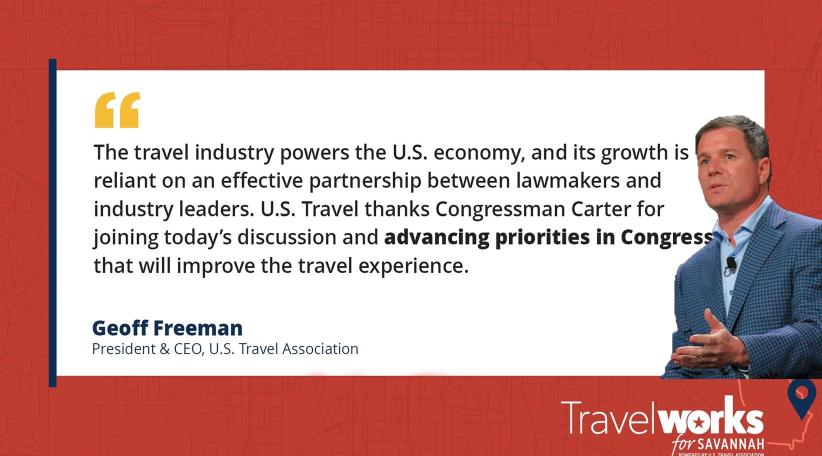
"The travel industry powers the U.S. economy, and its growth is reliant on an effective partnership between lawmakers and industry leaders," remarked Geoff Freeman, President and CEO of the U.S. Travel Association
The profound impact of the travel industry on the U.S. economy has been underscored once again as the U.S. Travel Association's "Travel Works for America" roadshow made a significant stop in Savannah. In a remarkable convergence, 20 prominent national and local figures from the travel and business sectors convened alongside U.S. Congressman Buddy Carter (R-GA) to delve into the indispensable contributions of travel to the nation's economic vitality. The Travel Works tour, a compelling endeavor, casts a spotlight on how travel serves as the bedrock for nearly every industry and community spanning the entirety of America.
"The travel industry powers the U.S. economy, and its growth is reliant on an effective partnership between lawmakers and industry leaders," remarked Geoff Freeman, President and CEO of the U.S. Travel Association. The collaborative efforts between legislators and industry representatives play a pivotal role in shaping the trajectory of the travel sector. U.S. Travel Association extends its gratitude to Congressman Carter for contributing to the ongoing dialogue and advancing congressional priorities that promise to enhance the travel experience.
Highlighting the immense impact of travel, the year 2022 witnessed travel spending generating a staggering $2.6 trillion in economic output, propelling the livelihoods of nearly 15 million American workers. This includes a considerable workforce of over 27,000 leisure and hospitality employees in Savannah. In Georgia alone, both domestic and international travelers injected $34 billion directly into the economy in 2021, fostering the sustenance of 422,600 jobs.
Despite the resumption of domestic leisure travel to pre-pandemic levels and a steady increase in business travel, the revival of international inbound travel—a crucial economic segment—is facing hurdles. The primary concern stems from the extended wait times experienced by travelers from our top 10 visa-requiring markets, who wait for over 400 days for a U.S. visitor visa. This prolonged waiting period serves as a significant deterrent to attracting new visitors and hampers a complete and rapid recovery.
Moreover, travelers arriving at major U.S. airports contend with average wait times of over an hour at Customs checkpoints due to a shortage of U.S. Customs and Border Protection officers. The imperative lies in prioritizing visa processing and ensuring adequate staffing at airports and entry points to remain competitive and harness the economic advantages associated with an influx of travelers.
Geoff Freeman further emphasized that Congress needs to concentrate on rectifying issues arising from the lack of federal progress in essential travel services. The adverse impact of waiting periods, such as the 400-day visa wait or the 13-week duration to obtain a U.S. passport, not only dissuades potential travelers but also inflicts economic repercussions on local economies and small businesses.
The 2023 Travel Works for America roadshow was inaugurated in the Washington, DC, region in May, spotlighting the travel industry's profound influence on the economy. The tour featured stops on Capitol Hill, Baltimore's Inner Harbor, and Alexandria, VA's Old Town. The upcoming Travel Works for America event is scheduled to take place in Detroit, Michigan, this September.
As the travel industry navigates through challenges and strives for a robust recovery, the harmonious collaboration between policymakers and industry leaders remains a critical factor. The dynamic synergy between these entities will undoubtedly pave the way for a vibrant and thriving travel landscape that benefits both the economy and the wider community.