- Región:
- Europe
- Categoría:
- Society
Coronavirus: England and France tightens restrictions
-
![Coronavirus: England and France tightens restrictions]()
New restrictions introduced in parts of northern England. French cities tighten virus rules. Spanish official says country not in second wave. Coronavirus: England and France tightens restrictions
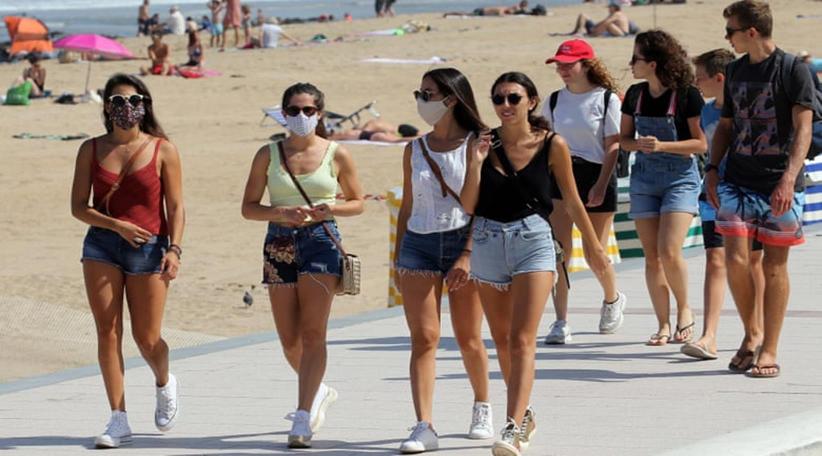
New restrictions introduced in parts of northern England.
French cities tighten virus rules.
Spanish official says country not in second wave.
Parts of the north of England have had a new face ban on indoor meetings between households introduced in the past half hour. The new measures apply to Greater Manchester, West Yorkshire and East Lancashire after increase in cases. (Specifically: Greater Manchester, Pendle, Hyndburn, Burnley, Rossendale, Blackburn with Darwen, Bradford, Calderdale, Kirklees, Leicester City).
The new measures mean:
People in the affected areas will not be permitted to mix with other households (apart from those in their support bubbles) in private homes or gardens.
Some exemptions will be put in place, including for the vulnerable.
The government will sign new regulations to make these changes legally enforceable.
The regulations will give local authorities and police forces the powers to enforce these restrictions and more details on these will be set out when the regulations are published.
Households may go to hospitality, for instance bars and pubs, but new guidance will make clear that two households should not go to hospitality together.
You can see the full details recently published on the Department of Health website. It says the measures were brought in because of an increasing trend in the number of cases per 100,000 people in the areas. Data suggested transmission among households was a key infection pathway in the area, the ministry said.
French cities tighten virus rules:
Face masks may need to be worn more widely in a number of French cities as cases continue to rise (masks are already required in all enclosed public spaces nationwide, including public transport).
In the Nord department adjacent to Belgium, the government’s top official said “reinforced measures” would be announced Friday, possibly making masks compulsory outdoors, in response to a surge in cases across the border.
The mayor of Saint-Malo, whose walled city has drawn tens of thousands of French tourists who opted to stay in the country for the summer holidays, said masks were now mandatory inside the old city and on the ramparts for everyone aged 11 and over.
“Masks are essential protection for limiting the virus’s spread,” Mayor Gilles Lurton said, after health authorities said the Ille-et-Vilaine region had 44 new cases on Wednesday alone.
Starting on Friday, masks will be required in open-air markets in Orleans, central France, and after 9:00 pm long the Loire river, where crowds of people have been gathering in the evenings.
The mayors of Bayonne and the nearby Atlantic resort of Biarritz also announced that face masks would be compulsory in their city centres starting next week. Biarritz will also ban access to its beaches at night to prevent parties being held there.
While far below the peak of crisis, the “R” rate of viral transmission – one of the key measures of how fast the virus is spreading – has risen to 1.3 nationwide. That means 10 infected people are infecting 13 others on average.
Spanish official says country not in second wave:
Spain’s health ministry’s emergencies coordinator, Fernando Simon, says the country is not experiencing a second wave of the virus, despite a fresh surge in infections in the country.
“I don’t know if there will be second waves in the future. This does not look to me to be it. If it was, we would be in a very different situation that we are now,” he told a news conference.
“There is no exact definition, here or anywhere else. What we could define as a second wave would be when we have widespread, uncontrolled community transmission ... right now that is not the situation in Spain.”