- Region:
- USA
- Category:
- Entertainment
Bad Bunny Makes History With Puerto Rican-Infused Super Bowl Halftime Show
![Bad Bunny Makes History With Puerto Rican-Infused Super Bowl Halftime Show.]()
Bad Bunny Makes History With Puerto Rican-Infused Super Bowl Halftime Show.
- Region:
- USA
- Category:
- Entertainment
- Author/s:
- Publication date:
SANTA CLARA, Calif. (Feb. 8, 2026) — Puerto Rican global superstar Bad Bunny delivered a historic and culturally resonant Super Bowl LX halftime show at Levi’s Stadium, transforming the NFL’s most-watched entertainment moment into a vibrant tribute to Puerto Rican identity, Caribbean culture and pan-American unity.
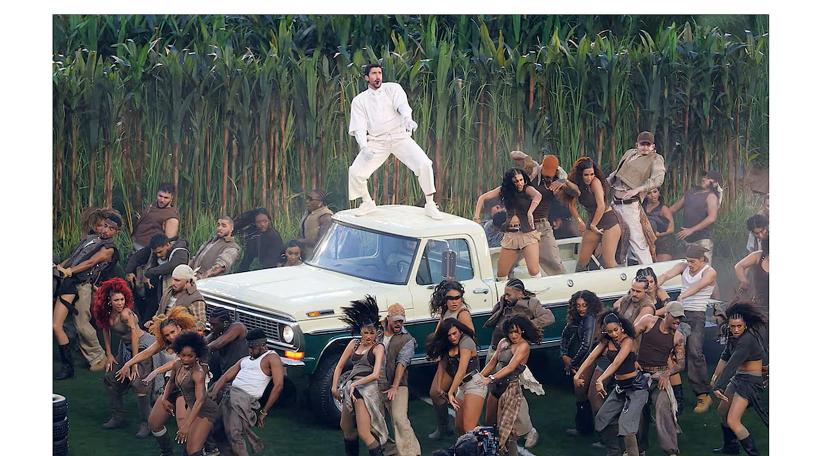
For approximately 13 minutes, the stage became a living canvas of Puerto Rico’s music, symbols and lived experience — from sugar cane fields and jíbaros (rural farmers wearing pavas, traditional straw hats) to La Casita, a replicated Puerto Rican home setting that anchored much of the performance.
Opening with Tití Me Preguntó and Yo Perreo Sola, Bad Bunny (born Benito Antonio Martínez Ocasio) used reggaeton, Latin trap and salsa-infused choreography to bring the rhythms of his Caribbean heritage to millions around the world.
Landscape of Performance and Special Guests
The multimedia sequence included:
- La Casita: A detailed set visually evoking Puerto Rican neighborhoods, complete with domino players, farmers, and a piragua (shaved-ice) stand.
- Surprise Appearance by Lady Gaga: Emerging from a staged wedding scene, Gaga performed her part of Die With a Smile in salsa style alongside Bad Bunny. Her outfit featured the maga, Puerto Rico’s national flower.
- Ricky Martin Moment: The iconic Latin crossover artist joined for Lo Que Le Pasó a Hawai, adding emotional weight and historical continuity.
- Grammy Tribute: Bad Bunny celebrated his recent win for Album of the Year (Debí Tirar Más Fotos), the first all-Spanish album to achieve that distinction.
The show also honored reggaeton pioneers — including a brief nod to Daddy Yankee’s Gasolina — acknowledging the foundation laid by earlier Puerto Rican artists.
Symbols, Messages, and Cultural Claims
Bad Bunny’s performance crossed pure entertainment into cultural advocacy and political symbolism:
- Flag and Identity: The artist raised the Puerto Rican flag and performed El Apagón — a song that references the aftermath of Hurricane Maria and ongoing infrastructure challenges on the island — in a powerful visual moment highlighting resilience and critique of systemic neglect.
- Pan-American Unity: Near the show’s end, Bad Bunny spoke in English, saying “God Bless America” and enumerating countries across the Americas — Chile, Argentina, Uruguay, Brazil, the United States and Canada — before affirming, “And my motherland, mi patria, Puerto Rico, seguimos aquí.”
- Core Message: A stadium backdrop displayed “The only thing more powerful than hate is love,” echoing Bad Bunny’s recent Grammy speech and reinforcing themes of inclusion, pride and cultural affirmation.
Bad Bunny’s choice to perform mostly in Spanish — a first in Super Bowl halftime history — marked a decisive elevation of Latin music and language on one of the world’s biggest media stages.
Reaction and Broader Context
The show sparked widespread conversation:
- Praise Across Social Media: Fans celebrated the energy, choreography and cultural themes, with viral responses emphasizing the “vibe” and Bad Bunny’s global pull.
- Criticism and Division: Some viewers and commentators online criticized the decision to perform primarily in Spanish or questioned the cultural pivot of the halftime show.
- Political Backdrop: The performance arrived amid political debate over immigration policy and national identity, with previous criticism from former President Donald Trump and conservative figures about the halftime booking.
Legacy and Significance
Bad Bunny’s Super Bowl appearance — headlining a universal broadcast that included NBC, Peacock, Telemundo and NFL+ — represents a watershed for Latin culture in mainstream entertainment. As the first mostly Spanish-language solo headliner at the halftime show, he symbolically shifted the center of the cultural moment while honoring his roots in Puerto Rico’s rich musical tradition.
The performance not only spotlighted reggaeton and Caribbean genres but also invoked deeper historical narratives and contemporary social realities — marrying spectacle with storytelling in a way rarely seen on this global stage.