- Region:
- Caribbean
- Category:
- Tourism
Kirl Grant-Hoschtialek: “Beyond Sun, Sea and Sand, Grenada Has a Wealth of Culture, Heritage and Experiences”
-
![Kirl Grant-Hoschtialek, Acting CEO of the Grenada Tourism Authority.]()
Kirl Grant-Hoschtialek, Acting CEO of the Grenada Tourism Authority.

GEORGETOWN, GUYANA. – During SOTIC 2026, the Caribbean Tourism Organization’s State of the Tourism Industry Conference in Georgetown, ABC MUNDIAL spoke with Kirl Grant-Hoschtialek, Acting CEO of the Grenada Tourism Authority, about Grenada’s tourism strategy, its three-island destination concept, cultural heritage, sustainability, marine tourism and the importance of ensuring that tourism benefits local communities.
SOTIC 2026 is being held in Guyana for the first time, under the theme “Tourism Futures: Smart, Sustainable and Inclusive.” The conference brings together Caribbean tourism ministers, government officials, destination executives, private-sector leaders and international stakeholders to discuss the future of the region’s tourism industry.
—What is Grenada showcasing to the world?
Kirl Grant-Hoschtialek: Grenada is so very beautiful. Of course, we are in the Southern Caribbean, so naturally it is about the sun, the sea and the sand.
But most importantly, it is about our distinctiveness.
Beyond sun, sea and sand, there are strong elements of sustainability and, most importantly, who we are as a people.
There is a lot of culture, cuisine and heritage.
We also have a strong nautical offering. We love when visitors come to explore our Underwater Sculpture Park, both in Grenada and in Carriacou, our sister island.
We position ourselves as a destination of three islands: Grenada, Carriacou and Petite Martinique.
It is three experiences in one destination.
—What new initiatives have you introduced?
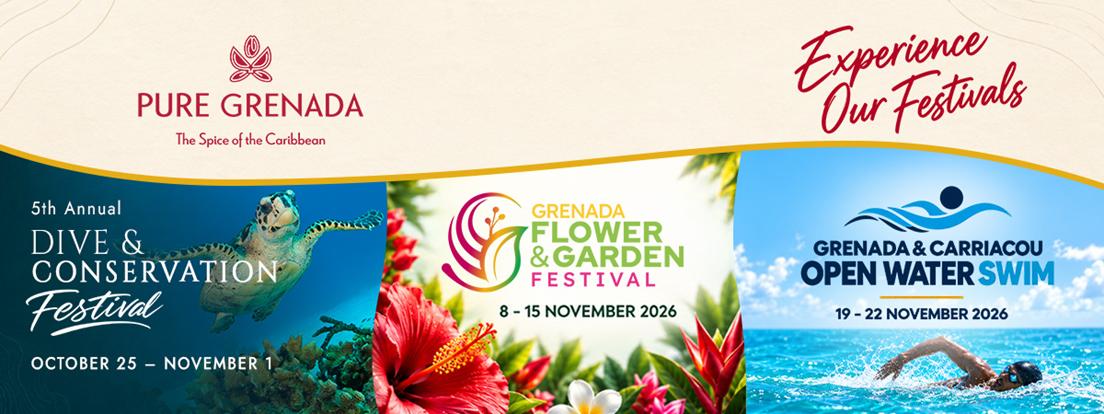
We have done a number of things this year. We launched two new festivals.
In January, we had the Lobster, Lambie & Seafood Festival on our sister island of Carriacou.
It was hugely popular because it supports sustainable tourism, local fishermen and the community.
There is also a strong yachting following and a connection with the diaspora.
We believe tourism has to be inclusive and self-sustaining in terms of the products and experiences we develop.
We also need to be smart about how we advance the tourism agenda.
—Travelers are changing. How is Grenada responding?
We know visitors are continuing to evolve.
We want to explore new markets for Grenada and expand the markets we already have. We are looking at our geographical market mix and trying to make some changes.
We need to understand what visitors are looking for.
And for Grenada, we say: we are really culturally rich.
We have our indigenous culture, Shakespeare Mas and Spice Mas.
—Shakespeare Mas? As in William Shakespeare?
Kirl Grant-Hoschtialek: Absolutely.
It is actually quite unique to Carriacou, our sister island.
There is the African heritage and the English influence from colonial times.
Over generations, people would quote lines from Shakespeare as part of the carnival activities.
They have headdresses, hand implements, masks and an entire costume tradition.
—When does that take place?
Normally in February or March, because that is the first carnival.
We have two carnivals.
There is Kayak Mas, which falls around the Ash Wednesday period, and then there is Spice Mas, which is our main national carnival and takes place in August.
Depending on the calendar, Kayak Mas can fall in February or March.
That is where you see Shakespeare Mas.
There is also a lot of food, including authentic African-rooted cuisine.
There are the Maroons, who prepare food and invite the community to share it.
There is also a strong percussion tradition, with string bands and drums.
That is a very strong element of the identity of Carriacou and Petite Martinique.
—You also have an important maritime tradition.
Kirl Grant-Hoschtialek: Yes. We are very strong in traditional boatbuilding.
We have two UNESCO-related inscriptions: one for wooden boatbuilding and another for Shakespeare Mas.
There is a boatbuilding school on the island, in Windward, one of the main areas of Carriacou.
A lot of young people are learning how to build those boats, and the tradition continues today.
People from as far away as the U.S. Virgin Islands and other northern areas come to buy those boats.
It is also part of our regatta tradition.
Carriacou is known as the Isle of Reefs, because there are many reefs around the island.
—What new experiences are you developing in Carriacou?
Recently, we installed an underwater sculpture experience called A World Adrift.
They are underwater sculpture pieces that look like prisms and small boats, with young people inside steering the vessels.
They represent the younger generation and what can happen in the future from a sustainability perspective.
We try to make sure that whatever products we introduce — whether it is Lobster, Lambie & Seafood, A World Adrift or our regattas — are truly inclusive and people-focused.
That is very important.
—And what does the main island of Grenada offer?
We have similar attributes.
We have beautiful beaches and, culturally, Spice Mas is by far our biggest carnival.
We have also been doing very well with different cultural elements, especially music.
We have a strong drumming tradition, performing arts and a whole creative industry, which is a very important part of the linkages within Grenada’s tourism product.
—What new campaigns are you preparing?
We are getting ready to launch two campaigns: Pure Escapes and Pure Experiences.
Pure Experiences will focus on heritage, culture, food, cuisine, spices, nautical activities and diving.
It will speak to many things where visitors can go into the community and become immersed in those experiences.
That gives them a better appreciation of what the island really has to offer.
Visitors can also experience nature trails and hiking, and see the Mona monkey, which is the only monkey of its origin found in the Eastern Caribbean.
That is another unique element of the island.
We have a diverse offer, both on the terrestrial side and in our nautical experiences.
And, of course, we have a strong culture that brings everything together.
—How do you make sure tourism benefits local communities?
We know the economy is important.
We want to make sure that whatever festivals and events we organize create a trickle-down effect back into the community.
To be inclusive means building from the ground up.
—How many people live in Grenada?
Approximately 120,000 people.
—And how many visitors do you receive?
We probably receive about 525,000 visitors a year.
—That is a significant number compared with the population.
Yes.
—Cruise tourism represents a large part of that figure?
Exactly.
Cruise is where the big numbers are.
It is more than 300,000 visitors, concentrated over approximately six months of the year.
We are therefore very careful about what that footprint will look like.
We monitor it very closely because we know that this is where our ceiling will be.
For stay-over visitors, we normally receive around 190,000 a year.
Right now, year to date, we are at approximately 140,000 visitors.
We are tracking very nicely.
We have a 9% increase in visitor arrivals year to date compared with 2025, and we feel that momentum will be sustained.