- Region:
- America
- Category:
- Politics
Lula and Flávio Bolsonaro Face Off in Brazil’s Most Unpredictable Election in Years
-
![Lula and Flávio Bolsonaro Face Off in Brazil’s Most Unpredictable Election in Years.]()
Lula and Flávio Bolsonaro Face Off in Brazil’s Most Unpredictable Election in Years.
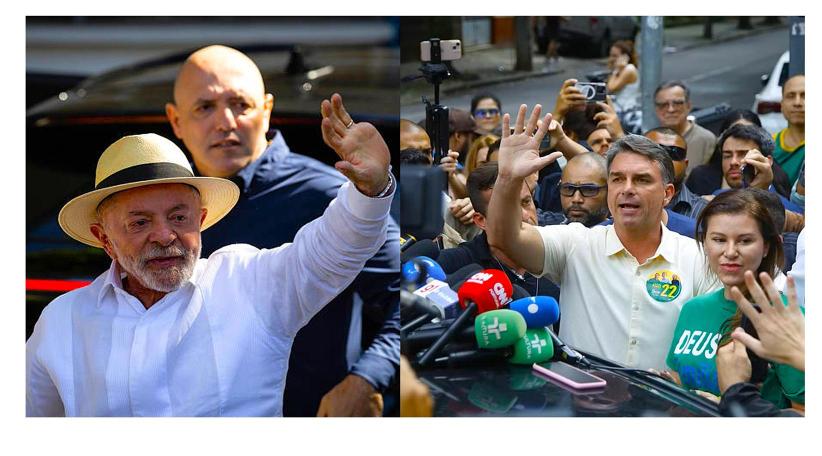
Brazil is voting this Sunday in one of the most unpredictable presidential elections in the country’s recent history, with President Luiz Inácio Lula da Silva and Senator Flávio Bolsonaro locked in a remarkably close race. Both candidates expressed confidence as they cast their ballots, while the latest polls point to a possible runoff.
Nearly 159 million Brazilian voters are heading to the polls to elect the country’s president, governors, senators and representatives in a highly polarized election that could define Brazil’s political direction for years to come.
President Luiz Inácio Lula da Silva, seeking another term in office, voted Sunday morning in São Bernardo do Campo, in the ABC Paulista region, a city closely associated with his political and trade union history. He was accompanied by Vice President Geraldo Alckmin, Fernando Haddad, Marina Silva, Simone Tebet and other political allies.
After voting, Lula delivered one of his strongest messages of the campaign’s final hours. He said the election represents a choice between “strengthening democracy or barbarism” and stated that he was confident of winning. He also downplayed the latest opinion polls, arguing that what ultimately matters is the result at the ballot box.
“What is at stake is the definition of a project for Brazil,” Lula said after voting, stressing that the country must choose between strengthening democracy and what he described as barbarism.
Lula is seeking a fourth presidential term, after previously winning elections in 2002, 2006 and 2022. He is expected to follow the vote count from São Paulo.
Flávio Bolsonaro also predicts a first-round victory
Flávio Bolsonaro, the Liberal Party (PL) candidate and son of former president Jair Bolsonaro, voted shortly after polls opened at a school in Vila Isabel, in Rio de Janeiro.
After casting his ballot, Flávio reiterated his expectation of winning in the first round, citing internal campaign polling. He said he was “more than ready” to lead the country and promised to restore what he described as Brazilians’ “right to dream.”
In another statement after voting, Flávio called on voters opposed to Lula to support his candidacy in order to avoid a runoff, presenting himself as the protest vote against the current government.
The two candidates therefore arrived at election day with sharply contrasting messages. Lula framed the election as a defense of democracy and his political project, while Flávio Bolsonaro focused on economic dissatisfaction, crime, taxes and opposition to the current government.
A race too close to call
The latest polls released on the eve of the election showed an extremely tight contest. The final Quaest poll placed Lula at 46% of valid votes against 45% for Flávio Bolsonaro, within the survey’s two-point margin of error. Other polls also indicated a technical tie.
The uncertainty means that neither candidate can be considered a clear favorite. If no presidential candidate receives more than 50% of the valid votes, Brazil will hold a second round on October 25.
The election is taking place against a backdrop of intense political polarization. Lula is campaigning on social programs, employment, democracy and national sovereignty, while Flávio Bolsonaro is seeking to consolidate the conservative vote around security, economic growth, a smaller state and the political legacy of his father.
Beyond the presidential race, Brazilians are also electing members of Congress and governors, making the composition of the next legislature another crucial factor for whoever occupies the Planalto Palace.
For now, Brazil enters election night without a clear winner. Lula and Flávio Bolsonaro both left their polling stations expressing confidence, but the final decision will come from the electronic ballot boxes — and the possibility of a second round remains very strong.