- Region:
- USA
- Category:
- Tourism
86% of Americans Say They Felt Joy Watching World Cup Visitors Enjoy the U.S., US Travel Association Survey Finds
-
![86% of Americans Say They Felt Joy Watching World Cup Visitors Enjoy the U.S., US Travel Association Survey Finds.]()
86% of Americans Say They Felt Joy Watching World Cup Visitors Enjoy the U.S., US Travel Association Survey Finds.
A new survey commissioned by the U.S. Travel Association shows the 2026 FIFA World Cup delivered far more than record attendance figures — it reshaped how Americans feel about welcoming international visitors, according to polling conducted by Morning Consult among 2,205 U.S. adults, with oversamples of 331 respondents in Houston and 330 in Kansas City.
The numbers behind the goodwill
Two-thirds of Americans nationally (63%) said they knew the U.S. was co-hosting the 2026 World Cup, a figure that climbed to 89% in Kansas City and 78% in Houston. Nationally, 39% of Americans reported watching at least some of the tournament, a share that rose to roughly half of residents in both host cities.
The data show that direct contact with international visitors changed everything. Among Americans who personally interacted with a World Cup visitor, viewership jumped to 79% nationally — 85% in Houston and 76% in Kansas City. Half of Americans nationally (50%) said they had seen news or social media coverage of international tourists' experiences in the U.S., rising to 77% in Kansas City and 66% in Houston, and the overwhelming majority who saw that coverage described it as positive.
Personal interaction, however, remained relatively rare: just 17% of Americans nationally reported speaking directly with a World Cup visitor, compared with 27% in Kansas City and 26% in Houston.
Pride, joy and the reputational case for tourism
The survey's headline finding: 81% of Americans said watching international visitors enjoy the country's food, culture and attractions gave them a sense of pride in being American, while 86% said it brought them genuine joy. Those numbers were even higher in host cities — 88% in Houston and 90% in Kansas City reported greater pride from watching visitors' experiences.
Asked why a positive visitor experience matters, Americans ranked reputation and safety above economics: 61% said it reflects positively on America's standing in the world, 50% said it helps keep the country safe by building goodwill with other nations, and 43% cited the direct economic benefit to American businesses and workers. Smaller shares pointed to visitors serving as long-term "ambassadors" for the U.S. (42%) or becoming more likely to buy American products (36%).
Seven in ten Americans (70%) said the U.S. should pursue hosting more major global events like the World Cup, the Olympics or a World's Fair — a figure that rose to 82% in Kansas City and 81% in Houston.
On the question of who best represents American culture to the world, 50% of Americans nationally — and 54% in Houston and 71% in Kansas City — said an in-person visit gives international travelers the most accurate picture, ahead of news or social media. Notably, among Americans who had actually met a World Cup visitor, 34% pointed to social media as the more accurate cultural lens, versus just 11% of those without that direct contact.
The tournament also produced a clear fan favorite: 43% of Americans nationally named Lionel Messi their favorite player, ahead of Cristiano Ronaldo at 32% — a gap that widened to 60%-versus-Ronaldo in Kansas City and 48% in Houston.
Industry leaders echo the findings
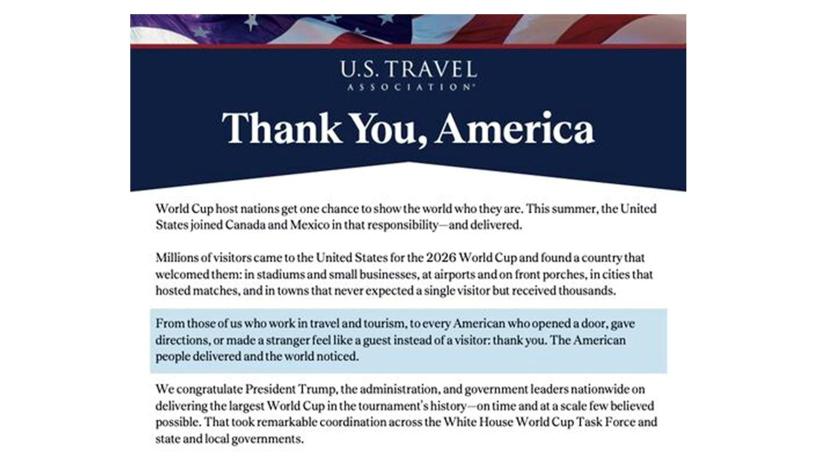
The survey's release coincided with an open letter published this week in The Wall Street Journal, signed by CEOs of the country's largest travel companies and led by U.S. Travel National Chair and MGM Resorts CEO and President Bill Hornbuckle. The letter thanked the American public, host communities and the Trump administration for helping deliver a successful tournament and urged continued cooperation ahead of the 2028 Olympics and other major international events.
"The World Cup reintroduced America to the world," said Geoff Freeman, president and CEO of the U.S. Travel Association. "Our best ambassadors aren't politicians or headlines — they're the Americans visitors met, the communities they explored and the people who made them feel welcome. That's a win for every American."
A note of caution on policy
Despite the overwhelmingly positive numbers, the survey found unease about policies that could slow the momentum, including a proposed $250 entry fee and expanded social media screening for international visitors. More respondents said restricting or complicating entry to World Cup host cities would hurt local businesses and communities than said it would help.
"The World Cup showed what's possible when America welcomes the world," Freeman said. "Now the challenge is making sure we keep our foot on the pedal — not create obstacles that deter the visitors we want to attract."