- Region:
- USA
- Category:
- Society
Supreme Court: Top US judges signal support for abortion limits
-
![upreme Court: Top US judges signal support for abortion limits]()
Anti-abortion activists are urging the court to "protect unborn children", but experts warn of an increase in maternal mortality if abortion is restricted. upreme Court: Top US judges signal support for abortion limits
Justices signal they’ll OK new abortion limits, may toss Roe
In the biggest challenge to abortion rights in decades, the Supreme Court’s conservative majority on Wednesday signaled they would allow states to ban abortion much earlier in pregnancy and may even overturn the nationwide right that has existed for nearly 50 years.
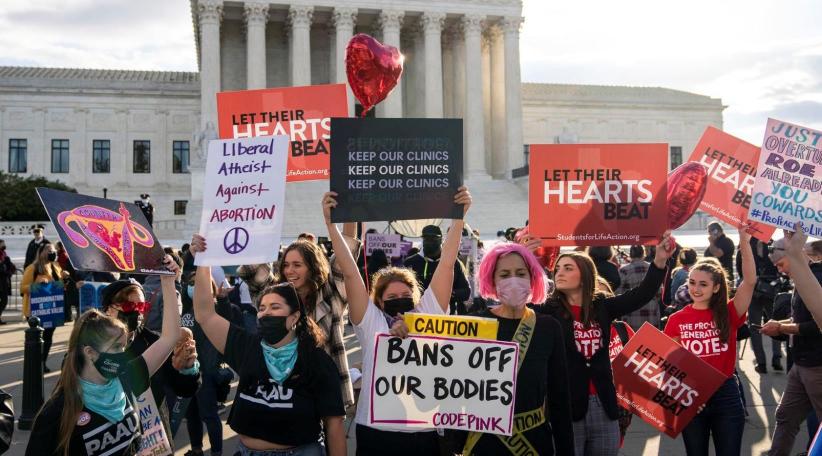
With hundreds of demonstrators outside chanting for and against, the justices led arguments that could decide the fate of the court’s historic 1973 Roe v. Wade decision legalizing abortion throughout the United States and its 1992 ruling in Planned Parenthood v. Casey, which reaffirmed Roe.
The outcome probably won’t be known until next June. But after nearly two hours of arguments, all six conservative justices, including three appointed by former President Donald Trump, indicated they would uphold a Mississippi law that bans abortion after 15 weeks of pregnancy.
At the very least, such a decision would undermine Roe and Casey, which allow states to regulate but not ban abortion up until the point of fetal viability, at roughly 24 weeks.
And there was also substantial support among the conservative justices for getting rid of Roe and Casey altogether. Justice Clarence Thomas is the only member of the court who has openly called for overruling the two cases.
The US Supreme Court appears poised to accept a Mississippi law that would bar abortions after 15 weeks of pregnancy, even in cases of rape or incest.
In Wednesday's hearing into the case, conservative justices hinted that a majority backed upholding the law.
A ruling, expected in June, may see millions of women lose abortion access.
Anti-abortion activists are urging the court to "protect unborn children", but experts warn of an increase in maternal mortality if abortion is restricted.
Both sides of the debate regard this case, known as Dobbs v Jackson Women's Health Organization, as an all-or-nothing fight over abortion rights.
Lawyers defending the Mississippi law have asked the court to overturn two previous landmark decisions regarding abortion.
The first, 1973's Roe v Wade, gave women in the US an absolute right to an abortion in the first three months of pregnancy, and limited rights in the second trimester.
In 1992, in Planned Parenthood v Casey, the court ruled that states could not place an "undue burden" on women seeking abortions before a foetus could survive outside the womb, at about 24 weeks.
In the years since, the "foetal viability" standard has acted as a red line in abortion law, preventing any bans on abortion before this time.
But anti-abortion campaigners hope the current ideological makeup of the court has created a new opening.
The Supreme Court is the highest tribunal in the US, and rules on legal appeals involving constitutional and federal law.
It has been reshaped by three appointments under former President Donald Trump, and has been called the most conservative-leaning in modern US history - with a six-to-three conservative majority.
If the court strikes down Roe v Wade, or rules that the Mississippi law does not place an undue burden on women seeking abortions, at least 21 states are expected to introduce abortion restrictions, including outright bans after 15 weeks.
In these states, nearly half of US women of reproductive age (18-49) - some 36 million people - could lose abortion access, according to research from Planned Parenthood, a healthcare organisation that provides abortions.