- Region:
- USA
- Category:
- Politics
Trump Warns Maduro It Would Be “Smart” to Step Aside as U.S. Pressure on Venezuela Intensifies
![Trump Warns Maduro It Would Be “Smart” to Step Aside as U.S. Pressure on Venezuela Intensifies.]()
Trump Warns Maduro It Would Be “Smart” to Step Aside as U.S. Pressure on Venezuela Intensifies.
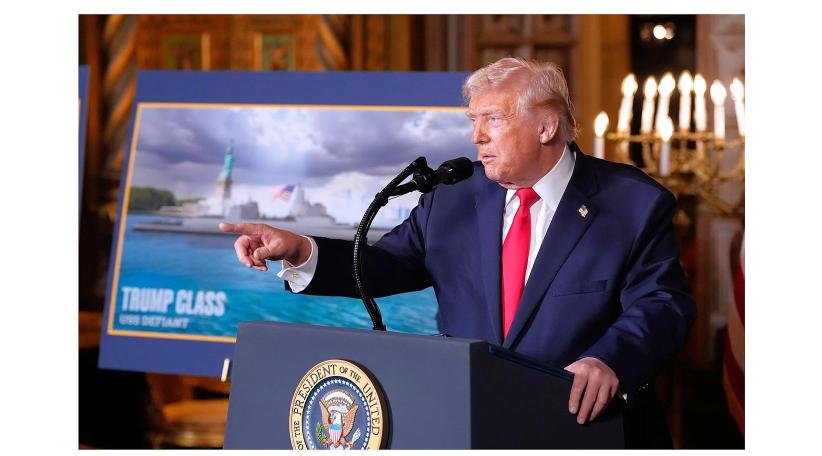
U.S. President Donald Trump escalated tensions with Venezuela this week, warning that it would be “smart” for President Nicolás Maduro to relinquish power, as the United States continues an aggressive campaign targeting Venezuelan oil shipments and maritime activity in the Caribbean.
Speaking Monday in Palm Beach, Trump confirmed that U.S. authorities remain in active pursuit of an oil tanker linked to Venezuela more than 24 hours after the operation began. “It’s moving along and we’ll end up getting it,” he said, reiterating claims that the vessel originated from Venezuela, despite reports indicating it was sailing toward the country when the U.S. Coast Guard attempted to interdict it.
The tanker, identified as Bella 1, is the latest focal point in a broader U.S. effort to cut off Venezuela’s oil revenues, a strategy that has included the interception of at least two other tankers this month and a significant U.S. naval buildup in the Caribbean Sea.
“A Massive Armada”
Trump declined to clarify Washington’s ultimate objective in Venezuela but again raised the possibility of land strikes, adopting unusually blunt language toward Maduro.
“We have a massive armada — the biggest we’ve ever had, and the biggest we’ve ever had in South America,” Trump said. “He can do whatever he wants. If he plays tough, it’d be the last time he’s ever able to play tough.”
Pressed on whether the administration is seeking to force Maduro from power, Trump stopped short of a formal declaration but made his position unmistakable: “That’s up to him. I think it’d be smart for him to do that.”
The remarks come days after Trump ordered what he described as a “complete blockade” of sanctioned oil tankers traveling to and from Venezuela. The president also suggested that seized oil could be added to the U.S. Strategic Petroleum Reserve, signaling a willingness to turn enforcement actions into long-term leverage.
Divisions Within the Republican Party
Trump’s increasingly confrontational posture has exposed deep divisions among Republican lawmakers, particularly over the prospect of regime change in Venezuela.
While many Senate Republicans support aggressive action against Venezuelan vessels suspected of drug trafficking, several have voiced concern that direct military action against Maduro’s government could repeat past U.S. foreign policy failures.
“We just have to be very careful when we’re dealing with regime change. It seems to backfire a lot,” said Sen. Roger Marshall (R-Kan.), who nevertheless expressed support for Trump’s current measures.
Sen. Rand Paul (R-Ky.) was more direct, saying he opposes what he views as an emerging regime-change strategy. Paul criticized the administration for what he called inconsistent enforcement, noting that Trump recently pardoned former Honduran president Juan Orlando Hernández, who had been sentenced to 45 years in prison for drug trafficking.
“They’re designating governments terrorists now,” Paul said, warning that presidents are increasingly bypassing Congress’s constitutional authority to declare war.
Mixed Signals From the Administration
The debate has been fueled by conflicting messages from senior administration officials. Secretary of State Marco Rubio and Defense Secretary Pete Hegseth reportedly assured senators in classified briefings that regime change is not U.S. policy, framing the operations as part of a broader anti-narcotics strategy.
However, those assurances were undercut by comments from White House Chief of Staff Susie Wiles, who told Vanity Fair that Trump wants to keep escalating pressure “until Maduro cries uncle,” a remark widely interpreted as signaling regime-change ambitions.
“I don’t want another Afghanistan or Iraq,” said a Republican senator speaking anonymously, reflecting broader concerns about potential U.S. ground involvement.
Congressional Pushback
Trump’s rhetoric has already triggered legislative action. Last month, following his warning that U.S. strikes against Venezuela could begin “very soon,” Rand Paul joined Senate Democrats in introducing a war powers resolution aimed at blocking military hostilities without congressional authorization.
The measure is co-sponsored by Sens. Tim Kaine, Adam Schiff, and Chuck Schumer, highlighting rare bipartisan resistance to unilateral military escalation.
Meanwhile, defense hawks such as Sen. Lindsey Graham (R-S.C.) have criticized the administration for failing to articulate a clear endgame. “Most Americans want to know what happens next,” Graham said. “If Maduro goes, what happens after that?”
A High-Stakes Test for “America First”
The unfolding standoff presents a challenge for MAGA-aligned conservatives, many of whom oppose prolonged foreign entanglements but support Trump’s hard line against narco-trafficking.
As U.S. naval forces remain on high alert in the Caribbean, the central question persists: Is Washington enforcing sanctions and combating drug trafficking—or laying the groundwork for regime change in Venezuela?
For now, Trump’s warning to Maduro has added uncertainty to an already volatile regional crisis, one that could test both U.S. foreign policy doctrine and congressional authority in the months ahead.